Frutos da Santa Missa para a hora presente, por Pio XII |
|
Discurso aos Párocos e Pregadores Quaresmalistas, 23 de março, 1949.
Ao centro da
preparação dos fiéis muitos párocos colocaram a Santa Missa para os homens.
Nesta Missa, que reúne ao domingo os homens da paróquia, eles mostram para eles
a substância e o sentido da santa liturgia. O primeiro fruto de tal prática é de
fazer tomar parte de maneira consciente e pessoal no divino sacrifício do
altar.
Nós louvamos
tal costume no seu espírito e no seu método. Ele coloca o sacrifício da Missa no
seu verdadeiro lugar, no coração da vida e de toa a liturgia da Missa, sobretudo
quando se pensa na indecorosa ignorância de tantos sobre um mistério tão
sublime.
Todavia é de
suma importância considerar os efeitos que dela se irradiam para os homens, até
no campo eclesiástico e civil.
Realmente:
1. Instruídos e
habituados a venerar e amar o santo sacrifício da missa, os vossos homens
tornar-se-ão facilmente homens de oração e farão de suas famílias como um
santuário de oração. E isto é estritamente necessário. Quem poderia negar que o
espírito de oração vai diminuindo, enquanto que o espírito do mundo ganha
terreno até no seio da família, que pretende permanecer católica e fiel a
Cristo? Se a cruzada para a oração em família é acolhida com fervor em outros
países; se até conhecidos atores dos maiores centros cinematográficos do mundo
colocaram-se ao serviço de uma causa tão santa: como poderiam os católicos da
Cidade Eterna permanecerem nisto a eles inferiores?
2. Os homens
que se aplicam seriamente em penetrar o sentido e o alcance do sacrifício da
Missa, não podem deixar de avivar neles mesmos o espírito de domínio de si, de
mortificação, de subordinação das coisas terrenas às celestes, de absoluta
obediência à vontade e à lei de Deus, especialmente se vós tiverdes o cuidado de
inculcar neles tais sentimentos. É esta uma necessidade da hora presente, não
menos do que o renovado zelo pela oração, pois que hoje muitos - entre os quais
é doloroso ver também não poucos católicos - vivem como se o fim de tudo fosse
formar-se um paraíso sobre a Terra, sem pensamento algum para o além, para a
eternidade.
A tendência
natural do homem caído para as coisas terrenas, a sua incapacidade de
compreender as coisas do Espírito de Deus é infelizmente favorecida em nossos
dias pela cumplicidade de tudo quanto o circunda. Muitas vezes Deus não é
negado, nem injuriado, nem blasfemado; Ele é como que um grande ausente. A
propaganda para uma vida terrestre sem Deus é aberta, sedutora, contínua. Com
razão observou-se que geralmente, mesmo nos filmes indicados como moralmente
irrepreensíveis, os homens vivem e morrem como se não existisse Deus, nem a
Redenção, nem a Igreja. Nós não queremos aqui colocar em discussão as intenções;
não é porém verdade que as conseqüências destas representações cinematográficas
neutras, já se estenderam e aprofundaram? Adiciona-se ainda a isto a nefasta
propaganda deliberadamente dirigida para a formação da família, da sociedade, do
próprio Estado, sem Deus. É uma torrente cujas águas lodacentas tentam penetrar
até no campo católico. Quantos já foram contaminados! Com a própria boca, eles
se professam ainda católicos, mas não percebem que suas condutas desmentem com
os fatos aquela profissão de fé.
Não há portanto
mais tempo para se perder, para fazer parar com todas as forças este deslize de
nossas próprias fileiras na irreligiosidade e para acordar o espírito de oração
e de penitência. A pregação das primeiras e principais verdades da fé e dos fins
últimos, não somente nada perderam de sua oportunidade em nosso tempo, mas,
antes, tornam-se mais que nunca necessárias e urgentes. Também a pregação sobre
o inferno é atual. Por sem dúvida, semelhante argumento deve ser tratado com
dignidade e sabedoria. Mas quanto à substância mesma desta verdade a Igreja tem,
diante de Deus e dos homens, o sagrado dever de anunciar, de ensinar sem
qualquer atenuante, como Cristo a revelou, e não há nenhuma condição de tempo
que possa fazer diminuir o rigor desta obrigação. Ela atinge e liga em
consciência todo sacerdote a cujo ministério ordinário e extraordinário foi
confiada a cura de doutrinar, admoestar e guiar os fiéis. É verdade que o desejo
do céu é um motivo em si mesmo mais perfeito do que o temor das penas eternas;
mas disto não se deduz que ele seja para todos os homens também o motivo mais
eficaz para mantê-los distantes do pecado e convertê-los a Deus.
Meditai as
palavras que o Senhor, na vigília de sua Paixão, dirigiu ao Apóstolo Pedro. "Eis
que Satanás procura joeirar-te como o grão de trigo"; palavras de um
impressionante significado no momento em que vivemos. Valem não somente para os
pastores, mas também para toda a grei. Nas formidáveis controvérsias religiosas,
das quais somos testemunhas, não se pode contar senão com fiéis que oram e se
esforçam, mesmo a preço de grandes renúncias, por conformar suas vidas à lei de
Deus. Todos os demais, na ordem espiritual - e disto se trata - oferecem-se
indefesamente aos golpes do inimigo.
3. Um efeito da
Missa para os homens, efeito salutar não só para eles pessoalmente, mas também
para as famílias, será que fecharão os olhos e o coração a tudo o que na
imprensa, nos filmes, nos espetáculos, ofende o pudor e viola a lei moral. Onde,
realmente, senão aqui, deverá verdadeiramente operar o espírito de penitência e
de abnegação em união com Cristo?
Quando se
pensa, de uma parte, nas nauseantes cruezas e coisas impuras, colocadas em
amostra nos jornais, nas revistas, nas telas, nas cenas, e de outra parte, as
inconcebíveis aberrações dos progenitores que vão com seus filhos deleitarem-se
com semelhantes horrores, o rubor sobe à face, rubor de vergonha e de desprezo.
A luta contra aquela peste, especialmente assinalando-lhe as manifestações às
autoridades públicas, conseguiu já confortante resultado, e Nós nutrimos
esperanças que ela será sempre mais eficaz e benéfica.
Graças ao céu,
em algumas nações, particularmente naquelas de maior produção cinematográfica,
os católicos trabalham metodicamente e com feliz sucesso para a moralização e
dignidade dos filmes.
4. Nós
esperamos da comum assistência dos homens à Santa Missa também outro fruto de
capital importância: queremos aludir ao espírito de docilidade e de plena adesão
ao Romano Pontífice, e de fraterna e estreita união entre os fiéis, toda vez que
se trata de defender a causa da Igreja.
A causa da
Igreja! Seus inimigos desencadearam contra Ela uma violenta campanha de palavras
e de escritos. Para eles todos os argumentos, também os mais absurdos, são bons,
se servem para o fim a que tendem, e este fim é o de desagregar a unidade e a
cooperação dos católicos, de abalar a confiança para com o Vigário de Cristo,
para com os bispos e o clero. A arma preferida por eles é a calúnia, porque
sabem muito bem que nunca ela é totalmente inofensiva, mas inocula nos espíritos
a dúvida, a suspeita, a crítica, e nos corações um desafeto, que por vezes chega
até ao ódio. Assim a obediência e a concórdia são expostas ao perigo de se
tornarem a pouco e pouco corruptas e de serem destruídas. Relede a palavra de
Cristo sobre o "pai da mentira": o mesmo vale para esta campanha de
calúnias.
Bem outros
frutos podem ainda recolher-se da Missa para os homens. Nós não mencionamos
senão alguns entre os que pareciam mais corresponder à necessidade da hora e
melhor servir à preparação interna dos fiéis.
Pio XII
|
terça-feira, 30 de outubro de 2012
Frutos da Santa Missa para a hora presente, por Pio XII
Cristo, Rei dos reis : O Reino de Cristo está nest...
segunda-feira, 29 de outubro de 2012
In 1947 Pope Pius XII wrote Mediator Dei, the Church’s first encyclical on liturgy.


.jpg)
Venerable Pope Pius XII
.jpg)
Fully Conscious, and Active Participation
0
 In 1947 Pope Pius XII wrote Mediator Dei, the Church’s first encyclical on liturgy. Pope Pius XII reminds us that; “The worship rendered by the Church to God must be, in its entirety, both interior as well as exterior.” (Mediator Dei, 23). Earlier Pope St. Pius X in his Motu Proprio, On the Restoration of Sacred Music (1903) commented that in order to acquire the Christian spirit the “first and most indispensable source” is “active participation in the sacred mysteries and in the public and solemn prayer of the Church.” Pope Pius XII continues; “It is unquestionably the fundamental duty of man to orientate his person and his life towards God” (MD 13). He defines liturgy as;
“The sacred liturgy is, consequently, the public worship which our Redeemer as Head of the Church renders to the Father, as well as the worship which the community of the faithful renders to its Founder, and through Him to the heavenly Father. It is, in short, the worship rendered by the Mystical Body of Christ in the entirety of its Head and members.”Pope Pius XII connects this idea to the sacrifice of Jesus Christ;
The Church prolongs the priestly ministry of Jesus Christ mainly by means of the sacred liturgy. She does this in the first place at the altar, where constantly the sacrifice of the cross is represented, and with a single difference in the manner of its offering, renewed. She does this next by means of the sacraments, those special channels through which men are made partakers in the supernatural life. She does this it, finally, by offering to God, all Good and Great, the daily tribute of her prayer of praise.” (MD 3)The Church prolongs the priestly ministry of Jesus
- By means of the sacred liturgy.
- By means of the sacraments.
- By offering to God, “the daily tribute of her prayer of praise.” (MD 3)
Earlier in Sacrosanctum Concilium 7 the Council Fathers highlighted the various ways in which Christ is present in His Church:
To accomplish so great a work, Christ is always present in His Church, especially in her liturgical celebrations. He is present in the sacrifice of the Mass, not only in the person of His minister, “the same now offering, through the ministry of priests, who formerly offered himself on the cross” [20], but especially under the Eucharistic species. By His power He is present in the sacraments, so that when a man baptizes it is really Christ Himself who baptizes [21]. He is present in His word, since it is He Himself who speaks when the holy scriptures are read in the Church. He is present, lastly, when the Church prays and sings, for He promised: “Where two or three are gathered together in my name, there am I in the midst of them” (Matt. 18:20). (SC 7).The ultimate purpose of the liturgy is to make present the Paschal Mystery. The Fathers of the council continue noting that through the liturgy of the sacraments and sacramentals the faithful are given graces which sanctify almost every event in their lives and that “they are given access to the stream of divine grace which flows from the paschal mystery of the passion, death, the resurrection of Christ, the font from which all sacraments and sacramentals draw their power.” (SC 61).
Fully Conscious, and Active Participation
The phrase in Sacrosanctum Concilium 14 “fully conscious, and active participation” became a kind of “sound bite” or “catch phrase” after the council but note the line continues. . .
Mother Church earnestly desires that all the faithful should be led to that fully conscious, and active participation in liturgical celebrations which is demanded by the very nature of the liturgy. (SC 14 my emphasis).The phrase “fully conscious, and active participation” is qualified by the phrase “which is demanded by the very nature of the liturgy.” What do the council Fathers have in mind? Sacrosanctum Concilium Paragraphs 5 through 13 have carefully laid out the true nature of the liturgy.
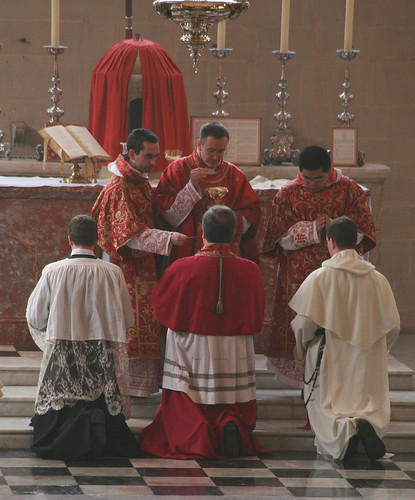
We are called to reverently enter into the re-presentation of the Paschal Mystery to meet the risen Christ present in the minister, the proclamation of the Word, in His sacramental Body and Blood, and in his Body the Church.
Sacrosanctum Concilium 19 gives the following advice;
With zeal and patience, pastors of souls must promote the liturgical instruction of the faithful, and also their active participation in the liturgy both internally and externally, taking into account their age and condition, their way of life, and standard of religious culture. By so doing, pastors will be fulfilling one of the chief duties of a faithful dispenser of the mysteries of God; and in this matter they must lead their flock not only in word but also by example. (SC 19).Pope Benedict reminds us, “To express one of its main ideas for the shaping of the liturgy, the Second Vatican Council gave us the phrase participatio actuosa, the “active participation” of everyone in the opus Dei [work of God], in what happens in the worship of God. (The Spirit of the Liturgy, 171). This does not mean that as many people as possible, as often as possible need to be involved but that everyone takes part in the action of liturgy. May God forbid that someone might think this means handing out the tambourines! Remember that the term “active participation” was originally used (1903, 1947) in relation to what we now call the Extraordinary form of the Mass. As the Holy Father points out, “the word ‘participation’ refers to a principal action in which everyone has a ‘part’.” (SL, 171)
St. Augustine views our common partaking of the Eucharist as a participation or ‘communion’ with Christ’s sacrifice, and a sharing in Christ’s immortality. St. Paul refers to the notion of sacrifice in Roman’s twelve, where he writes;
1I appeal to you therefore, brethren, by the mercies of God, to present your bodies as a living sacrifice, holy and acceptable to God, which is your spiritual worship. 2Do not be conformed to this world but be transformed by the renewal of your mind, that you may prove what is the will of God, what is good and acceptable and perfect. (Romans 12:1-2).St. Augustine comments on this passage in his book the City of God. He notes, “Thus a true sacrifice is every work which is done that we may be united to God in holy fellowship [ut sancta societate], and which has a reference to that supreme good and end in which alone we can be truly blessed” (City of God, X.6). St. Augustine interprets this sacrifice as the soul rising up in contemplation of God and being transformed by this union. The soul becomes “a sacrifice when it offers itself to God, in order that, being inflamed by the fire of His love, it may receive of His beauty and become pleasing to Him, losing the shape of earthly desire, and being remolded in the image of permanent loveliness” (City of God, X.6). We can see from this passage that we are all called to make our lives holy sacrifices to God. St. Paul’s appeal is not to a few chosen individuals but to all the brothers and sisters in Rome. Every aspect of our life is affected. The “renewal of our minds” will help us to seek God’s will in every aspect of our lives. In contrast with the Jewish notion of sacrifice the “Temple” of our sacrifice is now the world around us.
Our interior and exterior participation in Mass makes it “fully conscious, and active” without necessarily having to take on a formal liturgical role. We all participate together in the Sacrifice of the Mass.
http://mybhi.org/fully-conscious-and-active-participation/
GRANDEUR OF THE MASS
 Hoc est Corpus Meum; Hic est Sanguis Meus.
Hoc fácite in meam commemoratiónem.
O the grandeur and simplicity of the Mass of the Divine Power! With words so brief and so unostentatious Our Lord gave fulfillment to one of the solemnest of prophecies:
“From the rising of the sun even to the going down, My Name is great among the Gentiles: and in every place there is Sacrifice and there is offered to My Name a Clean Oblation. For My Name is great among the Gentiles” (Malach. 1:2).
The glory of God’s Name and knowledge of It spread throughout the world: these are the fruits of the Holy Sacrifice of the New Covenant. It is the divine bestowal in answer to the first petition of the Our Father: Hallowed be Thy Name. How often of my Jesus, I have felt ashamed of the fruitlessness of my priesthood! I made a sad mistake. With just the daily celebration of the Mass I co-operate to bring about the greatest good of God and of creatures: the furtherance of the glory of the Lord.

To consecrate the Body and Blood of Christ is the Church’s mightiest exercise of power. To approach with imperiousness, with three words, the Right Hand of God, the Bosom of the Father, and there to lay hold, in a certain sense, on the Only-Begotten Son and bring Him down to earth; to renew each day, each hour, each moment, over the face of the earth, the most glorious, the most meritorious feat of the Word of God, His Sacrifice; to earn, to seek, and find, for all Her countless children their daily Bread, and to feed them with It… almost force It upon them, lest they hunger, faint and die. O Lord! For this alone Thy Church is worthy to be named mankind’s chief Benefactress, and this our priestly dignity, the greatest and holiest power for good on earth.

The Holy Mass, besides being the chief act of adoration and submission to God, and therefore the primary expression of worship, is the most effectual of supplication. It has been the Church’s tactics in every age to put before the eyes of God the Name of His own Son; She has never dared to pray without this recommendation: per Dóminum nostrum Jesum Christum Fílium Tuum. How much greater, then, will Her appeal be in the sight of the Father when She presents to Him not merely the Name and remembrance of His Son but the very Son in Person, real and consubstantial with Him, seated on His Right Hand and likewise offering Himself on Calvary!

Such is the grandeur of the August Sacrifice of Our Altars that God has brought the downfall of every other religious sacrifice in Its trail. Polytheistic religions fell, and with them their sacrifices, human sacrifices very often as in ancient America. The new religions appearing after Christ, even heterodox Christian cults, are without sacrifice and sacrificer. But in Thy Church, O Lord, Thou hast wished to perpetuate the Offering of the Pure and Only Victim, the Lamb of God that taketh away the sins of the world.
RESPECT FOR THE MASS AND THE CELEBRANT

Pope St. Gregory says: “Who will doubt that at the moment of the Immolation the Heavens open? Or that the Angelic choirs are in attendance at this Mystery of Jesus Christ? And that the highest and the lowest, the visible and invisible, become one thing? Et summa et ima sociáre unúmque ex invisibílibus et visibílibus fíeri?” St. John Chrysostom, Augustine, and other Fathers expound the same ideas. According to them, during the Holy Sacrifice, the Altar is surrounded by legions of glorious spirits. What wonder that Angels should attend, and attend with infinite self-abasement, where the very Lord of the heavenly choirs stoops to such depths of infinite condescension! I quite believe it. What I find difficult to believe is that a worm of the earth like me should be invested with such an awe-inspiring dignity, and that in my hands should become incarnate, as it were, the “full of grace and of truth,” the Only-Begotten of the Womb of the Virgin Mary.

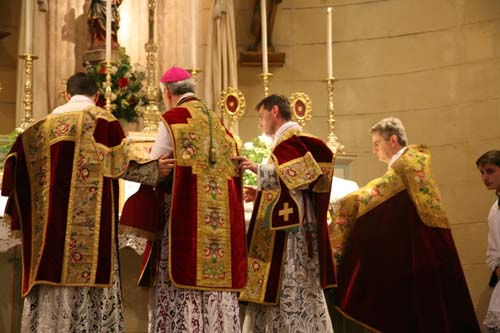
Let us consider the tremendous respect with which theChurch, in Her Liturgy, surrounds the Celebrant. He can be the humblest of priests, an unknown chaplain or curate, one lacking in virtue and learning and without social standing; but scarcely has he reached the Altar to say Mass, when he is given all the honors and preferences. Would Jesus Christ Himself be given better treatment were He to appear in Person as Sacrificer, robed in the Sacred Vestments? All the faithful, without exception: kings, princes, bishops, and even the Roman Pontiff, if present, will remain on bended knees while the Celebrant stands; and in reciting the Confíteor, the Pope himself will bow towards him and say: Et tibi, Pater… et te, Pater, and will prostrate to receive his blessings. How clearly the rubrics and ceremonies give to understand that during the most Holy Sacrifice only two persons demand attention and supreme respect: Jesus Christ, under the Sacramental Species, and the Priest, whose voice is instrumental of Christ’s Presence!

The Mass is the very Immolation of Calvary, and therefore, the goal of Christ’s coming to the world and living in mortal flesh. And in the Mass, the same as on Golgotha, there can intervene, at least attend, a great variety of people in a variety of roles. What is the role of the Priest when celebrating? Will he be one of Christ’s executioners? One of the soldiers offering the Victim gall and vinegar? One of those cruel adversaries who mock at His sorrows and blaspheme? One of the crowds of the merely inquisitive who get a thrill from the tragic details of an execution? Or will he be found among those good souls who believe in Christ and accompany Him in His prayer and Agony? Will he stand between the Mother and the beloved Disciple? NO. My place and role, when saying Mass, is pre-eminent: I have identified myself with the Divine Victim and Sacrificer, with the Lamb of God and the Eternal Priest Who immolates It; through my lips speak the lips, the Omnipotence, and the Heart of Christ: Hoc est Corpus Meum; Hic est Sanguis Meus.

Resolution
1) I promise my Lord, and I promise myself, in my great representative capacity at the Altar, at least a profound interior respect. And exteriorly, I shall see to it that wherever the Mass is concerned there shall be absolute conformity with the prescriptions [Rubrics] of the Liturgy, especially in connection with the cleanliness of vestments, sacred vessels, altar clothes, corporals, purificators, etc.; and also in the tidy appearance of the church and its Altars. I shall bear out the truth of my daily declaration: Dómine, diléxi decórum domus tuæ (Ps. 21:8).

2) And since the veneration which the Mass inspires the faithful depends, in no small measure, upon the priest’s pious observance of the rubrics, I propose to revise the ceremonies of the Missal, so that in all earnestness, and as soon as possible, I may examine my conscience on how I abide by them.
I desire, for the Savior’s sake, to win the compliment paid to St. Vincent de Paul: “There indeed you have a priest who says Mass well!”








Assinar:
Postagens (Atom)