- Foi o Papa Paulo VI, ele mesmo, que falou de autod...
- Das ultimative Ziel der Messe ist das Opfer des Lo...
- Pope Benedict XVI condemned all manner of religiou...
- Benedicto XVI : “La humanidad no puede manifestars...
- Benedikt XVI-Predigt an Neujahr : Noch umfangen ...
- Le Pape appelle les responsables des nations à déf...
- Noworoczna Msza papieska: tylko Bóg daje pokój, od...
- Bento XVI :A paz é “o dom messiânico por excelênci...
- Ultimate End. This is that of the Sacrifice of pra...
- 1º: La Misa es un Sacrificio verdadero y visible -...
- La fin prochaine de la Messe consiste en ce qu’ell...
- El fin próximo de la Misa consiste en que es un sa...
- O propósito imanente da Missa é fundamentalmente o...
- Beato Ildefonso Schuster e sua Obra: Liber Sacrame...
- Primeiras Vésperas da Solenidade da Santíssima Mãe...
- Benedetto XVI alla Celebrazione dei Vespri e Te De...
- Christmas in Des Moines,Iowa : The celebrant was M...
- Cardinale Raymond Leo Burke : a Sacra Liturgia è l...
- O jovem Dom Alexander King Sample, bispo da dioces...
- Quei segni perduti dell'identità cattolica di Vi...
- Mons. Fellay: La vida de la Iglesia ha cambiado co...
- Why Celebrate Mass in Latin? Why pray in Latin or ...
- CÓMO EL ERROR DEL LIBERALISMO SOCAVA LA FE CATÓLIC...
- La laïcité est d’essence satanique !
- Convegno di Roma sul Vaticano II, 16 dicembre. Tes...
- Bilancio 2010 della Tradizione Cattolica : Nel cor...
- * A Very Merry Christmas in Overbrook * Some r...
- A Very Merry Christmas in Overbrook
- Some reasons I prefer to attend the Tridentine Mas...
- Mass in the Extraordinary Form at St Charles in Hu...
- UN HOMBRE PARA LA ETERNIDAD: LA PELÍCULA GANADORA ...
- No domingo, 26 de dezembro, Sua Eminência o Cardea...
- BENEDETTO XVI : santa Caterina da Bologna individu...
- " La sainte soutane, dit M. Olier, est un signe ex...
- cardeal Siri : Ritengo di attirare la attenzione s...
- El uso de la sotana o del clergyman en sí sólo tie...
- As 7 excelências da batina : 1ª RECORDAÇÃO CONSTA...
- the obligation of priests to dress as priests in p...
- # Midnight Mass of Christmas – St. Mary’s Church, ...
- Midnight Mass of Christmas – St. Mary’s Church, No...
- Mons. Negri: Yo estoy de acuerdo en que el Papa d...
- Domenica 19 dicembre, il giorno successivo all'ord...
- Breve esame critico del «Novus Ordo Missæ»: La def...
- Bref examen critique du nouvel Ordo Missae : La dé...
- BREVE ESTUDO CRÍTICO DA NOVA ORDENAÇÃO DA MISSA 5 ...
- Card. Ottaviani intervention : The definition of ...
- Cardenal Alfredo Ottavianni BREVE EXAMEN CRITICO D...
- * Dom Prosper Guéranger, OSB : El ciclo litúrgico ...
- Dom Prosper Guéranger, OSB : El ciclo litúrgico ll...
- Dom Prosper Guéranger, OSB : We apply the name of ...
- dom Prosper Guéranger : Diamo il nome di Tempo di...
- Dom Guéranger : Nous donnons le nom de Temps de No...
- Recordamos hoy a San Juan, Apóstol y Evangelista
- Prymas Belgii odprawi pontyfikalną Mszę św. tryden...
- FSSP: em Lyon na França
- L´ "ermeneutica della continuità nella riforma" d...
- Cardinal Cañizares Llovera, the Prefect of the Con...
- On the day of Saint John, the priest may bless the...
- cardinale Antonio Cañizares Llovera: «La riforma ...
- Raymond Leo Cardinal Burke sang Pontifical Mass at...
- Una interesante carta inédita del Cardenal Ratzing...
- Salutiamo gli amici di Genova in questo momento in...
- Card.Siri : Nella colluvie di cose dette e scritte...
- La "querelle liturgique" a d'abord été conçue comm...
- Le vere cause e il vero rimedio dei mali odierni d...
- África y la forma extraordinaria
- Pope Benedict XVI called for renewed commitment to...
- Papst Benedikt XVI. beklagt Anschläge auf Kirchen ...
- Benoît XVI : il est donc très important que chaque...
- El Niño que vemos en la gruta es Dios mismo que se...
- Bento XVI: “Jesus nasceu num estábulo, tendo como ...
- BENEDETTO XVI :Quant’è importante, allora, che ogn...
domingo, 1 de janeiro de 2012
# Foi o Papa Paulo VI, ele mesmo, que falou de autod... # Das ultimative Ziel der Messe ist das Opfer des Lo... # Pope Benedict XVI condemned all manner of religiou... # Benedicto XVI : “La humanidad no puede manifestars... # Benedikt XVI-Predigt an Neujahr : Noch umfangen ... # Le Pape appelle les responsables des nations à déf... # Noworoczna Msza papieska: tylko Bóg daje pokój, od... # Bento XVI :A paz é “o dom messiânico por excelênci... # Ultimate End. This is that of the Sacrifice of pra... # 1º: La Misa es un Sacrificio verdadero y visible -... # La fin prochaine de la Messe consiste en ce qu’ell... # El fin próximo de la Misa consiste en que es un sa... # O propósito imanente da Missa é fundamentalmente o... # Beato Ildefonso Schuster e sua Obra: Liber Sacrame...
Pope Benedict: "Jesus a voice that speaks of Peace"
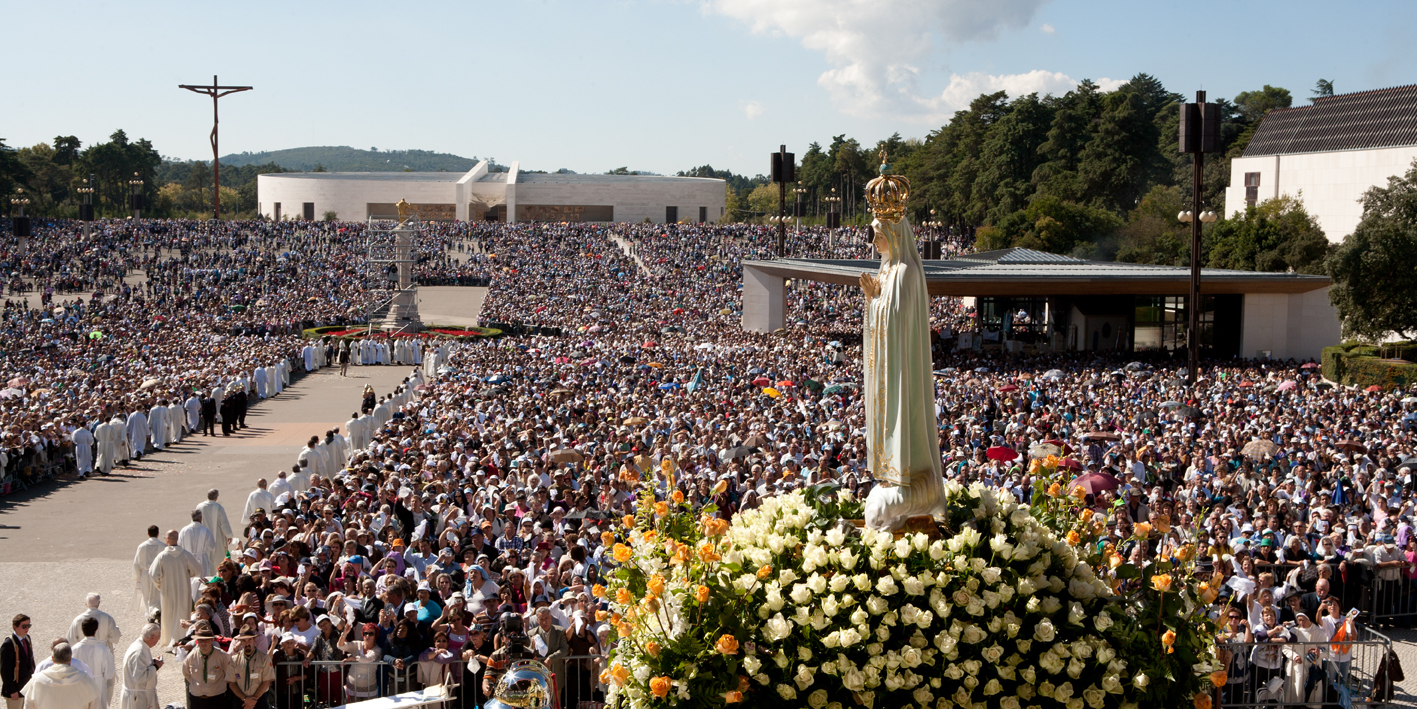
  A chilly morning in Rome did nothing to dissuade pilgrims, visitors and families with young children from filling St Peter’s Basilica this morning for the Pope’s first public Mass of the new year, a Mass marking both a Feast Day and an international commemoration – as Seàn-Patrick Lovett reports. On the first day of the New Year, the Church turns to Our Lady, dedicating January 1st to Mary the Mother of God. It’s also the day on which the Pope invites us to reflect on the theme of Peace. January 1st 2012 marks the 45th World Day of Peace and so both Mary and Peace were at the heart of the Pope’s homily during the solemn Mass celebrated in St Peter’s Basilica on Sunday morning. “Mary”, said Pope Benedict XVI, “is the Mother and model of the Church, who receives the divine Word in ...» |
Permanecer en la luz de Cristo: María Santísima Madre de Dios, tierra buena
| 2012: tiempo de esperanza y de pacífica convivencia, Ángelus Domingo, 1 ene (RV).- (Audio)   En el primer Ángelus dominical de este año que hoy comienza Benedicto XVI, antes de rezar la tradicional plegaria mariana dominical, saludó a los fieles invocando para todos: “que el Señor haga brillar su rostro sobre ti y te muestre su gracia. Que el Señor te descubra ...» En el primer Ángelus dominical de este año que hoy comienza Benedicto XVI, antes de rezar la tradicional plegaria mariana dominical, saludó a los fieles invocando para todos: “que el Señor haga brillar su rostro sobre ti y te muestre su gracia. Que el Señor te descubra ...»  |
|
Domingo, 1 ene (RV).- Primero de enero de 2012, Solemnidad de María Santísima Madre de Dios y 45ª Jornada Mundial de la Paz bajo el tema “Educar a los jóvenes en la Justicia y la Paz”. A las 9.30 de la mañana la celebración de la Santa Misa en la Basílica Vaticana. A las 9.30 en la Basílica de San Pedro tuvo lugar la celebración ...»
O Evangelho de Cristo é também o Evangelho da justiça e da paz: Bento XVI na Missa do Dia mundial da paz, sublinhando a responsabilidade de educar para a paz
 (1/1/2012) Assumir a responsabilidade de educar os jovens significa encarar o futuro com esperança. Um empenho que constitui um verdadeiro desafio e inclui naturalmente formar na justiça e na paz. Na homilia da Missa deste primeiro de Janeiro, na basílica de São Pedro, Bento XVI ilustrou brevemente o tema deste quadragésimo quinto Dia Mundial da Paz – “Educar os jovens na justiça e na paz”.
 O Santo Padre comentou antes de mais as leituras da Missa, a começar pela primeira, com a antiga bênção sacerdotal, que invoca a luz do rosto de Deus resplandecendo sobre os fiéis, com o dom da paz. De acordo com esta fórmula de bênção – observou – “para ser abençoado, é preciso estar na presença de Deus… permanecer no cone de luz que parte do seu Rosto, no espaço iluminado pelo seu olhar, que difunde graça e paz”.
Mas é precisamente do Menino, Jesus, que contemplamos neste dia ao colo de sua Mãe santíssima, que irradia a luz da bênção divina. É dele que vem a bênção: do seu nome (Jesus, que significa “Deus salva”) e do seu rosto humano. A primeira a ser cumulada desta bênção foi Maria, escolhida por Deus para ser a Mãe do Seu Filho feito homem. Maria é, como diz Isabel na sua saudação, “bendita entre as mulheres”.
“O mistério da sua divina maternidade, que hoje celebramos, contém em medida superabundante aquele dom de graça que comporta toda e qualquer maternidade. A fecundidade do ventre sempre foi associada à bênção de Deus… Maria é mãe e modelo da Igreja, que acolhe na fé a Palavra divina e se oferece a Deus como terra boa na qual Ele pode continuar o seu mistério de salvação”.
Como Maria (prosseguiu o Papa), a Igreja é mediadora da bênção de Deus para o mundo: recebe-a acolhendo Jesus e transmite-a levando Jesus. É Ele a misericórdia e a paz que o mundo por si não pode assegurar-se e de que tem necessidade como pão e mais ainda.
“Caros amigos, a paz, no seu sentido mais pleno e mais elevado, é a soma e a síntese de todas as bênçãos. Quando duas pessoas amigas se encontram, cumprimentam-se desejando-se mutuamente a paz. Também a Igreja, no primeiro dia do ano, invoca de modo especial este dom supremo, e fá-lo, como a Virgem Maria, mostrando a todos Jesus”.
Foi neste contexto, que Bento XVI referiu, na parte final da homilia, o tema deste Dia mundial da paz 2012: “Educar os jovens para a justiça e para a paz é tarefa de todas as gerações e, graças a Deus, a família humana, depois das tragédias das duas grandes guerras mundiais, tem mostrado ter cada vez mais consciência disto mesmo… Para a Comunidade eclesial educar para a paz enquadra-se na missão recebida de Cristo, faz parte integrante da evangelização, porque o Evangelho de Cristo é também o Evangelho da justiça e da paz”.
Bento XVI referiu que “a Igreja nos últimos tempos se tem feito intérprete de uma exigência que envolve todas as consciências mais sensíveis e responsáveis pela sorte da humanidade: a exigência de responder a um desafio decisivo que é precisamente o desafio educativo”.
“perante as sombras que hoje em dia pesam sobre o horizonte do mundo, assumir a responsabilidade de educar os jovens para o conhecimento da verdade, para os valores fundamentais da existência, para as virtudes intelectuais, teologais e morais, significa encarar o futuro com esperança. E neste empenho por uma educação integral, entra também a formação na justiça e na paz”.
Os jovens de hoje crescem num mundo que se tornou, por assim dizer, mais pequeno, onde são constantes os contactos entre as diferentes culturas e gerações. “Hoje mais do que nunca (insistiu o Papa), é indispensável aprender o valor e o método da convivência pacífica, do respeito recíproco, do diálogo e da compreensão”.
“Trata-se essencialmente de ajudar as crianças, os adolescentes, a desenvolver uma personalidade que aliar um profundo sentido da justiça ao respeito do outro, à capacidade de enfrentar os conflitos sem prepotência, com a força interior de testemunhar o bem mesmo quando custa sacrifício, com o perdão e a reconciliação. Poderão assim tornar-se homens e mulheres verdadeiramente pacíficos e construtores de paz”.

* Pope Benedict XVI invites Christians reawaken in t... * Un nuevo año guiados por María: fe, esperanza y ca... * În cursul după amiezii Ora vesperală condusă de Pa... * Papstmessen zum Jahreswechsel * Un rinnovato ardore missionario per annunciare la ... * Benoît XVI confie à Dieu les drames et les espoirs... * Reavivar uma fé que instaure um novo humanismo cap.... * DIFUSION OF THE GREGORIAN MASS IN THE CATHOLIC CHU... * El año de Benedicto XVI * It's a Wonderful Life *HD* - Part 1 of 1 * O Filho de Deus nasce ainda "hoje" Bento XVI refl... * No domingo, 26 de dezembro de 2010, Sua Eminência ...
Dietrich von Hildebrand on the Rhythm, Scope and Primacy of the Sacred Liturgy

The following excerpts come from pp. 155-169 of Dietrich von Hildebrand's work, Liturgy and Personality (Longman's, 1943) in a chapter titled "The Spirit of Discretio." This particular passage touches on a variety of subjects we have raised here on NLM over the years, and particularly these past few months.
Some of the subjects addressed by von Hildebrand in this excerpt include:
Some of the subjects addressed by von Hildebrand in this excerpt include:
- a non-reductionst view of the sacred liturgy
- the relationship of the liturgy and non-liturgical devotions
- the hierarchical relationship of the liturgy and devotions
- the proper chants of the liturgy vs. hymns
- the progression of minor and major orders
The excerpt is lengthy, and I fear it may discourage some of you from reading it, but I would encourage you to make the effort. There is much to unpack here. To help identify some of these sections, I will bold some emphases within the text.
In the Liturgy we find the spirit of discretio expressed in its three lines of development. Its structure and atmosphere clearly testify to this spirit, and the man who lives in the Liturgy grows organically into that spirit.
Let us recall the structure of the Holy Mass. Behold its organic unfolding for participation in the mystery. it is not a hurried march towards the great final aim, Holy Transubstantiation. One is aware that certain stages must first be passed through. First the Introibo mounting with the Confiteor to the altar of the Lord, the confrontation with God, the prayer for the forgiveness of sins, and then the centering of the Mass on the mystery of the feast of the day, as expressed in the Introit. Then the Kyrie, the great solemn cry for mercy; the adoring praise and thanksgiving offered to God in the Gloria; the Oratio with the special allusion to the mystery of the feast of the day; the illumination and preparation of our spirit through the epistle or lesson. Then comes the praise of the Gradual and the Alleluia, which rise as an echo to the epistle; and then the even more solemn and deep illumination of the words of eternal life of the Gopsel. The Credo resounds as a solemn response to the revelation contained in the words of the Lord through an expressly professed Faith. All this is an organic preparation, an ascension toward the mystery. Then follows the Offertory in which we give ourselves up to Christ in order to be carried by Him and with Him to the Father; the elevation of the host and the chalice; and the Lavabo which is another purification on a higher scale, performed alone this time by the priest directly on the threshold of the mystery. But we still stand in the world of symbols; it is still the priest as representative of Christ who acts, while we participate in his act.
As we approach the mystery more closely, we hear the sursum corda. What a deep sense of the entirely new which is now on the point of beginning, of the inner elevation of our attitude to a new scale which is now demanded. But before Christ enters our midst to perform the sacrifice of the Cross, the solemn praise and thanksgiving for the magnalia Dei must resound once more in the Preface culminating the song of praise of the Angels: Sanctus, Sanctus, Sanctus! Now the last veil drops, the authentic actio begins, the celebration of the mystery itself. First, the ultimate, highest unfolding of the consciousness of communion -- the prayer for the Holy Church and its Head, the loving glance cast on our fellow men, the drawing of all into the mystery, the glorious vision of the Communion of Saints. And then, the world of symbols and of human acts fades away: Christ Himself, our Head, sacrifices Himself to His heavenly Father.
[...]
Truly we behold in the Holy Mass the primary image of the entire dramatic rhythm of being, all the stages which much be traversed, the necessity of ascension, and inner preparation for the utterance of an objectively genuine "Word." In the transubstantiation, we also behold the primal pattern of a full "now." Here we learn to know the moment charged with inner significance; here where time and eternity meet, we understand the ultimate essence of the full "now." But the further development of the Holy Mass is as organic as the ascension to the Holy Mystery. After participating expressly in the sacrifice of Christ, reaching its climax in the prayer Per ipsum, cum ipso et in ipso (Through Him, with Him and in Him), follows the third part of the Holy Mass, the sacrificial meal which is solemly initiated by the Pater Noster, the Lord's prayer. In the first part of the Pater, we once more are in the rhythm intended purely for the praise of God, which until now has dominated the entire sacrificial act. In the second part of the Pater we ask for the bread of life and the forgiveness of our sins...
[...]
We find in the structure of the Holy Mass the primal image of the sense of the dramatic essence of being, its inner laws of development and the necessity of passing through objectively presented stages. But this sense of dramatic rhythm is also expressed in many distinct elements of the Liturgy, as for instance in the incensing of the altar during the Kyrie and the Offertory, the incensing of the Gospel, as well as in the blessing received by the deacon before the reading of the Gospels. We also find it in the purification of the chalice and the ablution of the hands after communion, in the fact that the initial prayers are recited at the foot of the altar, as well as in many other details. These are not mere fortuitous creations of the rubrics, but the expression of the sense of different objective degrees and what must take place in each of these before we dare pass to the next one. They are the fruit of discretio.
We also find this spirit of discretio in the structure of the Breviary as well as in the articulation of the various Hours. They are all dominated by the clearly expressed sense of the rise, culminating in the point and decline, the organic unfolding of a single theme.
This spirit is reflected above all in the rite of baptism and the ritual of Holy Orders....
The Liturgy deeply expresses the sense of these various stages which are to be objectively passed through for an achievement of the final aim. This is also reflected in the fact that though today even for the baptism of adults the entire baptismal rite is compressed in a short space of time, the gradation of the liturgical steps have been preserved in tact...
The same is true of Holy Orders. There are seven different orders still separated in time even today, organically leading to the essential aim. What a discretio in the gradation of powers required by the various orders! How distinctly is there expressed here also that element of discretio in which the degrees of relationship with the Kingdom of God are clearly distinguished in the various acts directed towards God. The divine service of the reading of the epistle can be performed by one who is still only a sub-deacon; the divine service of the reading of the gospel and the preaching of a sermon is open only to the deacon. Whereas the latter may distribute Holy Communion, the priest alone can offer the Holy Sacrifice of the Mass.
[...]
This discretio is also clearly reflected in the distinction within the Liturgy between the sacraments and sacramentals. The wholly new degree of sacredness possessed by the sacraments in relation to the sacramentals is clearly expressed through the Liturgical treatment. Both are forms of divine service, both are destined to glorify God, yet they are distinctly separate in so far as their objective link with God is concerned. And how deeply is the entire Liturgy penetrated with the sense of the depth of the level at which something must be performed. Its own atmosphere of ultimate depth and of the presence of God, its profoundly sacred spirit, entirely irradiated by the face of Christ, prevents us from slipping onto the peripheral level so often presented by non-liturgical forms of devotion.
Everything in the Liturgy, even the singing, is formed by the spirit of Christ. What a world of ultimate greatness and truth, towering high above all individual deviations and entanglements, discloses itself in the solemnly uttered Deus in adjutorium meum intende! It draws us into the sacred realm where there is no place for anything profane.
And let us recall, on the other hand, the swamp of triviality and sentimentality into which certain modern religious hymns sink even though full of good and pious intentions. These hymns actually invite the faithful to drop into the superficial; they lead the outsider astray, for instead of offering him the true face of Christ, as revealed in the Liturgy, they falsify it through a sugary sentimentality. Instead of drawing us out of our narrowness into the pure mysterious atmosphere of the King of Eternal Glory, instead of revealing to us the entire "suavity," the mysterious splendour of the "fairest of the children of men," they lead us into a world of sentimentality and philistine narrowness repulsive even from the natural point of view. Many hymns induce the faithful to abandon the level of genuine religious emotion for the sphere of childhood memories; or else they incite to a profession of feelings of mere allegiance such as are typical of any Fourth of July gathering. This does not concern the purely aesthetic problem, but rather the question as to whether or not a hymn reflects the spirit of Christ, whether or not it is penetrated with a truly sacred atmosphere; it is the question of the level to which it leads us inwardly when we follow its spirit. Indeed it would be too naive to believe that the spirit of Christ is always reflected in everything which has been composed with the intention of edifying and is not heretical or immoral.
[...]
In the piety which is not determined by the Liturgy, the weight is easily shifted to that which is far less directly linked to God; it is shifted from the centre to the periphery. For many, attendance at the month of May devotions or rosary devotions appears as important as attendance at the Holy Mass on week-days. And even when they do not place them theoretically on the same scale, they actually give their preference to the devotions. Yes, many recite during Mass a prayer of devotion to Saint Joseph and Saint Anthony. For many, in the month of May, devotion to Mary overshadows Easter time. For them this devotion to Mary stamps the day far more than does the Easter Cycle. For many, solemn benediction appears as central as the Mass. For many, the visit to a famous place of pilgrimage is a more solemn contact with the supernatural than that obtained by participating in the Holy Sacrifice. They tremble in awe far more in touching a relic than in the Preparation during which we tread before the Lord's altar. Than man who is formed by the Liturgy possesses, on the contrary, the discretio which makes him more aware of the true degrees leading to the mystery, and also the narrower spheres within the divine service. He will fully affirm the venerable non-liturgical forms of piety; he will be fully aware of their beauty which belongs to them in so far as they are secondary branches of the primordial, but he will see and experience them in their right place where they objectively stand.
The Liturgy teaches us to put everything in its right place in the realm of God...
On the matter of the major and minor orders, on reading von Hildebrand's words in their regard, it put me to mind of the recent call made by Bishop Athanasius Schneider for a motu proprio re-establishing the minor orders and subdiaconate throughout the Latin rite.
http://www.newliturgicalmovement.org/2011/09/dietrich-von-hildebrand-on-rhythm-scope.html
sábado, 31 de dezembro de 2011
Pope Benedict XVI invites Christians reawaken in themselves the Longing for God .A vigil for peace in families and in the world

 On Saturday evening Pope Benedict XVI presided over the vespers to mark the end of the year 2011 and in the name of the whole Church, to thank God for all the benefits he bestowed to mankind and to ask pardon for the sins committed during the year. The liturgy took place in St. Peter’s Basilica and was attended by hundreds of the faithful including cardinals, bishops, priests, religious and laity. ...»
 A vigil for peace in families and in the world
On the eve of a new year and to mark the 45th World Day of Peace, a vigil will take place tonight in St Peter’s Square. People are being invited to pray for peace between nations and in families. The event is being organised by the Italian association Family of the Small Church.
“Every hour there is a particular community that prays during the night, in particular prays to Mary. The intention of this is to pray for peace in families and in the world”, says Cesare Bini, one of the movement’s members.
Cardinal Giovanni Lajolo, President Emeritus of the Governatorate of Vatican City State will begin the vigil at 11.15 pm .
It concludes at 7am Sunday morning 1st January. Listen to Lydia O'Kane's interview
...»
Un nuevo año guiados por María: fe, esperanza y caridad

Sábado 31 dic (RV).- Con las primeras Vísperas de la Solemnidad de María Santísima Madre de Dios, cada 31 de diciembre, y luego el primer día de cada año, octava de la Navidad, la Iglesia que peregrina en el mundo, unida al Santo Padre, contempla con especial ternura y esperanza a Jesucristo, el recién nacido Príncipe de la Paz:
Voz del Papa: La Iglesia celebra la solemnidad de Santa María, Madre de Dios, y también la Jornada Mundial de la Paz. Os invito a entrar en la escuela de la Virgen Santísima, fiel discípula del Señor, para aprender de Ella a acoger en la fe y en la oración la salvación que Dios quiere derramar sobre los que confían en su paz y amor misericordioso.
«El comienzo de un Año nuevo, don de Dios a la humanidad, es una invitación a desear a todos, con mucha confianza y afecto, que este tiempo que tenemos por delante esté marcado por la justicia y la paz», escribe Benedicto XVI en su mensaje para la Jornada Mundial de la Paz 2012. Alentando a mirar el nuevo año, con la bella imagen del salmo 130: el hombre de fe aguarda al Señor «más que el centinela la aurora» (v. 6), lo aguarda con una sólida esperanza, porque sabe que traerá luz, misericordia, salvación, el Papa - sin olvidar la crisis que agobia a la sociedad, al mundo del trabajo y la economía; una crisis cuyas raíces son sobre todo culturales y antropológicas – invita a la confianza. Con el lema de este mensaje, Benedicto XVI exhorta a «Educar a los jóvenes en la justicia y la paz», convencido de que ellos, «con su entusiasmo y su impulso hacia los ideales, pueden ofrecer al mundo una nueva esperanza».
Y qué mejor que concluir un año y empezar otro, acogiendo las incansables exhortaciones de Benedicto XVI a poner con total confianza todos nuestros proyectos e intenciones en las manos providentes de Dios, para que acompañados por María, sea Él el que guíe nuestros pasos cada día y acreciente en nosotros la fe, la esperanza y la caridad.
Para Radio Vaticano, Cecilia de Malak
În cursul după amiezii Ora vesperală condusă de Papa, adoraţie euharistică şi „Te Deum”

Duminică 1 ianuarie 2012: Sf. Maria Născătoarea de Dumnezeu şi Cea de-a 45-a Zi Mondială a Păcii. Papa oficiază Liturghia Euharistică în Bazilica Vaticană la ora 9.30
(RV - 31 decembrie 2011) Duminică 1 ianuarie, la ora 9.30 în Bazilica Vaticană Papa Benedict al XVI-lea prezidează Sfânta Liturghie în solemnitatea Sfintei Maria, Născătoarea de Dumnezeu şi Cea de-a 45-a Zi Mondială a Păcii. Concelebrează cu Sfântul Părinte cardinalul Tarcisio Bertone, secretar de Stat, cardinalul Peter Turkson, preşedintele Consiliului ...»
|
(RV - 31 decembrie 2011) Benedict al XVI-lea, sâmbătă la ora 17.00 conduce rugăciunea canonică vesperală - primele vespere - la solemnitatea Sfintei Maria Născătoare de Dumnezeu. Ora canonică este urmată de expunerea Preasfântului Sacrament, cântarea imnului „Te Deum” de mulţumire la încheierea anului civile şi binecuvântarea euharistică ...»
Papstmessen zum Jahreswechsel
Papst Benedikt feiert an diesem Freitagabend um 17 Uhr zum Jahresausklang eine Vesper im Petersdom. Danach wird er wie jedes Jahr die am 24. Dezember enthüllte Krippe auf dem Petersplatz segnen. Am Neujahrstag, liturgisch das Hochfest der Gottesmutter Maria, zelebriert Benedikt XVI. den traditionellen Gottesdienst zum Weltfriedenstag mit anschließendem Angelusgebet. Radio Vatikan überträgt diese Messe live und mit deutschem Kommentar.
Zu guter Letzt: Ein herzliches Prosit Neujahr von unserer Redaktion!
(rv 31.12.2011)
...»
Un rinnovato ardore missionario per annunciare la fede. L'invito del Papa nella celebrazione dei Vespri con il tradizionale Te Deum. Al termine l'omaggio al Presepe in Piazza San Pietro
 Annunciare la fede nel Verbo fatto carne è il cuore della missione della Chiesa. Lo ha ribadito stasera il Papa nel corso della celebrazione, nella Basilica Vaticana, dei primi Vespri della Solennità di Maria Santissima Madre di Dio. Una celebrazione che si è conclusa con l’inno di ringraziamento Te Deum e la visita al presepe in Piazza San Pietro. Benedetta Capelli:
 (Te Deum)
Un canto, il Te Deum, per varcare la soglia del 2012 e per mettere nelle mani del Signore “le tragedie di questo mondo e le speranze di un futuro migliore”. Il Papa spiega così l’intensità di questo inno dopo aver ricordato l’attesa e la trepidazione di un nuovo anno che ci fa pensare a quanto la vita sia “breve ...»
Benoît XVI confie à Dieu les drames et les espoirs du monde entier

En début de soirée, ce samedi 31 décembre, Benoît XVI a présidé les premières Vêpres de la solennité de Sainte Marie, Mère de Dieu, suivies du Te Deum, le chant d’action de grâce pour l’année écoulée. La célébration s’est déroulée comme chaque année en la basilique Saint Pierre, en présence des autorités civiles, dont le Maire de Rome qui, conformément à la tradition, a offert au Pape un calice. Benoît XVI a consacré une large partie de son homélie à la vie et aux priorités pastorales du diocèse de Rome, dont il est l’évêque. Les disciples du Christ - a-t-il ...»
Reavivar uma fé que instaure um novo humanismo capaz de gerar cultura e empenho social: Bento XVI na celebração de Vesperas
(31/12/2011) Bento XVI presidiu esta tarde na Basílica de S. Pedro a celebração das primeiras vésperas da solenidade de Maria Santíssima Mãe de Deus, seguindo-se a exposição do Santíssimo Sacramento , o canto tradicional do Te Deum de fim de ano e a bênção eucarística.
É muito sugestivo, neste fim de ano, - disse o Papa na homilia - escutar novamente o anúncio jubiloso que o apóstolo Paulo dirigia aos cristãos da Galácia: «Quando chegou a plenitude do tempo, Deus enviou seu Filho, nascido de mulher, nascido sujeito à lei, para resgatar os que eram sujeitos à Lei, para que recebêssemos a adoção filial» (Gal 4,4-5). Essas palavras tocam o cerne da história de todos e a iluminam, antes, a salvam, porque desde o dia do em que nasceu o Senhor, chegou para nós a plenitude do tempo. Portanto, já não há mais lugar para a angústia diante do tempo que passa e não volta para trás; agora é o momento de confiar infinitamente em Deus, por quem sabemos ser amados, para quem vivemos e a quem a nossa vida se orienta, na espera do seu retorno definitivo. Desde que o Salvador desceu do Céu, o homem já não é mais escravo de um tempo que passa sem um porquê, ou que esteja marcado pela fadiga, pela tristeza, pela dor. O homem é filho de um Deus que entrou no tempo para resgatar o tempo da falta de sentido ou da negatividade, e que resgatou toda a humanidade, dando-lhe, como nova perspectiva de vida, o amor que é eterno.
Bento XVI salientou depois que a Igreja vive e professa esta verdade e quer proclamá-la novamente hoje, com renovado vigor espiritual. Nesta celebração, temos motivos especiais para louvar o Senhor pelo seu mistério de salvação, presente no mundo por meio do ministério eclesial. Temos muitos motivos de agradecimento ao Senhor por tudo o que a nossa comunidade eclesial, no coração da Igreja universal, realiza a serviço do Evangelho nesta Cidade.
O Papa deu graças ao Senhor, nomeadamente, pelo promissor caminho comunitário dirigido a adequar a pastoral ordinária às exigências do nosso tempo, por meio do projeto «Pertença eclesial e corresponsabilidade pastoral». Este tem o objetivo de colocar a evangelização em primeiro lugar; para fazer mais responsável e frutífera a participação dos fiéis nos Sacramentos, de tal forma que cada um possa falar de Deus ao homem contemporâneo e anunciar o Evangelho com eficácia aos que nunca o conheceram ou o esqueceram.
A questio fidei é também o desafio pastoral prioritário para a Diocese de Roma. Os discípulos de Cristo estão chamados a fazer renascer em si mesmos e nos demais a saudade de Deus e a alegria de viver n'Ele e de testemunhá-Lo, a partir da pergunta, sempre muito pessoal: Por que creio? É necessário conceder o primado à verdade, confirmar a aliança entre a fé e a razão, como as duas asas com as quais o espírito humano se eleva à contemplação da Verdade (cf. João Paulo II, Enc. Fides et ratio, Prólogo); tornar fecundo o diálogo entre o cristianismo e a cultura moderna; levar à redescoberta da beleza e da atualidade da fé, não como um ato em si mesmo, isolado, que diz respeito a algum momento da vida, mas como uma orientação constante, mesmo nas escolhas mais simples, que leva à unidade profunda da pessoa, tornando-a justa, ativa, benéfica, boa. Trata-se de reavivar uma fé que instaure um novo humanismo capaz de gerar cultura e empenho social.
Na sua homilia Bento XVI recordou que na Assembleia diocesana do passado mês de junho, a Diocese de Roma iniciou um caminho de aprofundamento sobre a iniciação cristã e sobre a alegria de gerar novos cristãos para a fé. De fato, anunciar a fé no Verbo feito carne é o cerne da missão da Igreja, e toda a comunidade eclesial deve redescobrir esta tarefa, com um renovado ardor missionário. As novas gerações que mais sentem a desorientação, acentuada também pela crise atual, não só econômica, mas também de valores, -salientou o Papa - têm necessidade, sobretudo, de reconhecer em Cristo Jesus «a chave, o centro e o fim de toda a história humana» (Conc. Vat. II. Gaudium et spes, 10).
Os pais são os primeiros educadores na fé dos seus filhos desde a mais terna idade; por isso, é necessário apoiar as famílias na sua missão educativa, por meio de iniciativas adequadas. Ao mesmo tempo, é desejável que o caminho batismal, primeira etapa do itinerário formativo da iniciação cristã, além de favorecer uma consciente e digna preparação para a celebração do Sacramento, dê a devida atenção aos anos imediatamente sucessivos ao batismo, com os itinerários apropriados que levem em conta as condições de vida das famílias. Neste contexto Bento XVI animou as comunidades paroquiais e as outras realidades eclesiais a continuarem a refletir para promover uma melhor compreensão e recepção dos sacramentos através dos quais o homem se torna participante da vida mesma de Deus. Que a Igreja de Roma - foram os votos do Papa - possa sempre contar com fiéis leigos, prontos a oferecer a sua contribuição pessoal para edificar comunidades vivas, que permitam que a Palavra de Deus entre no coração dos que ainda não conheceram o Senhor ou se afastaram d'Ele. Ao mesmo tempo, é oportuno criar ocasiões de encontro com a Cidade, que permitam um diálogo proveitoso com todos os que estão à procura da Verdade.
A Igreja nos sugere concluir o ano dirigindo ao Senhor o nosso agradecimento por todos os seus benefícios. É em Deus que deve terminar a nossa última hora, a última hora do tempo e da história. Esquecer este final da nossa vida significaria cair no vazio, viver sem sentido. Por isso, a Igreja coloca nos nossos lábios o antigo hino Te Deum. É um hino repleto da sabedoria de tantas gerações cristãs, que sentem a necessidade de elevar o seu coração, na certeza que estamos todos nas mãos cheias de misericórdia do Senhor.
«Te Deum laudamus!». Assim canta também a Igreja que está em Roma, pelas maravilhas que Deus realizou e realiza nela. Com a alma cheia de gratidão nos dispomos a atravessar o limiar do ano 2012, lembrando que o Senhor vela sobre nós e nos protege. Nesta tarde, queremos confiar-Lhe o mundo inteiro. Coloquemos em suas mãos as tragédias do nosso mundo e ofereçamos a Ele também as esperanças de um futuro melhor. Depositemos estes votos nas mãos de Maria, Mãe de Deus, Salus Populi Romani.
DIFUSION OF THE GREGORIAN MASS IN THE CATHOLIC CHURCH
Christmas in Shanghai
Our first Christmas photos come from Shanghai, China. This particular Mass was celebrated according to the usus antiquior.


Midnight Mass, Usus Antiquior, Rome

(Image courtesy of John Sonnen)
Solemn Mass (Usus Antiquior) in the Pantheon Commemorates Giovanna of Savoy
It was widely reported on various sites that a Solemn Mass in the usus antiquior was to be offered in the Basilica of S. Maria ad Martyres (i.e. the Roman Pantheon) on the 28th of February of this year. The Mass was being offered in commemoration of the tenth anniversary of the passing of Giovanna of Savoy and was being hosted by the "Associazione Mafalda e Giovanna di Savoia", which organization exists to promote the cause of her beatification and canonization, and "Rinnovamento nella Tradizione".
Present at the Mass were various dignitaries, including Principe Amedeo di Savoia Aosta, and his wife, Principessa Silvia, Honorary President of the Associazione Mafalda e Giovanna di Savoia. A representative of the mayor of Rome was in attendance, as were members of the Order of the Poor Knights of Christ, including their Grand Master, Dom Marcello Alberto Cristofani della Magione.
The Mass was offered by Don Riccardo Petroni, a priest of the Roman diocese, and ecclesiastical assistant to the association Familia Christi.
The following photos were published on the website of Rinnovamento nella Tradizione and sent to the NLM by the same.
Present at the Mass were various dignitaries, including Principe Amedeo di Savoia Aosta, and his wife, Principessa Silvia, Honorary President of the Associazione Mafalda e Giovanna di Savoia. A representative of the mayor of Rome was in attendance, as were members of the Order of the Poor Knights of Christ, including their Grand Master, Dom Marcello Alberto Cristofani della Magione.
The Mass was offered by Don Riccardo Petroni, a priest of the Roman diocese, and ecclesiastical assistant to the association Familia Christi.
The following photos were published on the website of Rinnovamento nella Tradizione and sent to the NLM by the same.


The full gallery of photos may be seen here.
The full report written by Rinnovamento nella Tradizione may be read here.
Christmas in France
We now turn our attention to France beginning with the FSSP parish in Bordeaux (the first two photos are from the Midnight Mass and the remainder from one of the Masses of Christmas Day):


Next, the FSSP parish in Lyon:


The parish of St-Eugene in Paris:

Usus Antiquior for the Feast of St. Pius V, Santa Maria Maggiore
Yesterday, for the Feast of St. Pius V in the calendar of the usus antiquior, Msgr. Guido Pozzo, Secretary of the Ecclesia Dei Commission, celebrated a Solemn Mass in the Borghese Chapel (Salus Populi Romani) of the Basilica of Santa Maria Maggiore in Rome -- the basilica where the the tomb of St. Pius V is found.

John Sonnen, as always, has the photos. Here are some of them.


First Usus Antiquior Mass Offered by Spanish Bishop
This 15th of January H.E. The Most Rev. Manuel Ureña Pastor, Archbishop of Saragossa, celebrated a solemn requiem in the usus antiquior in the parish church of Epila in his diocese. This is the first time a Spanish bishop has offered the holy sacrifice of the Mass in the Extraordinary Form in Spain since the promulgation of Summorum Pontificum. The Mass, which was also concluding the restauration works which had been carried out in the church, was attended by 1,200 faihtful, including various government representatives. The Misa de Réquiem by Mariano Rodríguez de Ledesma was sung. Msgr. Ureña had celebrated a burial according to the usus antiquior books in the same church last year, cf. NLM article here.


Photos and information: Una Voce Málaga.






In addition, for those of you interested in the talks presented at the conference, the following are free to listen to and download online:
The Place of the Holy Mass in Our Daily Lives - Father James Fryar, FSSP
Instilling a Sense of the Sacred - Doctor Thomas Kaiser
On Sacraments and Sacramentals - Father James Fryar, FSSP
As well, the music from the Mass has been made available here.
The Harvard Latin Mass Society have sent us some photos of the Mass.


A photo set from the Mass has been made available.


Photos and information: Una Voce Málaga.
First Usus Antiquior Mass Offered at Thomas More College
Late in August we made mention here of the fact that Thomas More College in New Hampshire was introducing the usus antiquior into the campus liturgical life. This was to be inaugurated on October 7th, the Feast of Our Lady of the Rosary.
In follow-up to that announcement, we are pleased to present some photos from that Mass.
In follow-up to that announcement, we are pleased to present some photos from that Mass.


Usus Antiquior Conference at Thomas Aquinas College
On September 10th, Una Voce Ventura hosted a conference at Thomas Aquinas College, "Applying the Fruits of the Extraordinary Rite to Family Life."
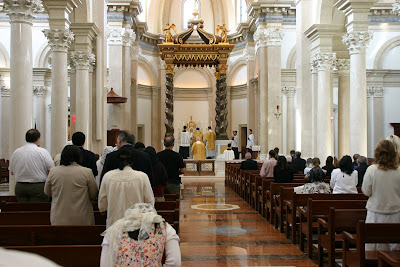
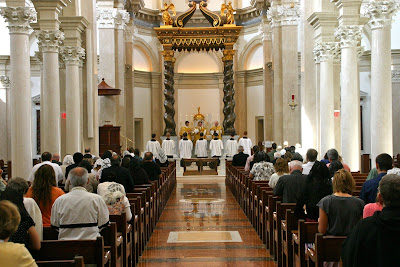
The conference included a Solemn Mass offered in TAC's beautiful chapel, offered by Fr. Paul Raftery, OP, the chaplain to Thomas Aquinas College, with Fr. James Fryar, FSSP acting as deacon and Fr. Gregory Heidenblut, OSA, as subdeacon. Seven students of TAC acted as servers, and the schola was also provided by TAC, under the direction of Dr. John Nieto.
A full photo album has been made available here. Here is a selection.
The conference included a Solemn Mass offered in TAC's beautiful chapel, offered by Fr. Paul Raftery, OP, the chaplain to Thomas Aquinas College, with Fr. James Fryar, FSSP acting as deacon and Fr. Gregory Heidenblut, OSA, as subdeacon. Seven students of TAC acted as servers, and the schola was also provided by TAC, under the direction of Dr. John Nieto.
A full photo album has been made available here. Here is a selection.


In addition, for those of you interested in the talks presented at the conference, the following are free to listen to and download online:
The Place of the Holy Mass in Our Daily Lives - Father James Fryar, FSSP
Instilling a Sense of the Sacred - Doctor Thomas Kaiser
On Sacraments and Sacramentals - Father James Fryar, FSSP
As well, the music from the Mass has been made available here.
Usus Antiquior at Harvard University
As readers will know, we here at the NLM are always eager to promote and report on Masses in either the usus antiquior or in a "reform of the reform" vein which are taking place at university campuses and amongst university students. Accordingly, we were delighted to hear of the following Mass which took place at the prestigious American ivy league school, Harvard University, in Cambridge, MA.:
On Friday, March 25, 2011, the Holy Sacrifice of the Mass was offered in the Extraordinary Form of the Roman Rite at Harvard University. Father Patrick Armano, Pastor of St. Monica Parish in Methuen, MA, celebrated Low Mass for the Annunciation of the Blessed Virgin Mary, at the high altar of St. Paul Catholic Church in Harvard Square, Cambridge, MA. The Mass was a Dialogue Mass.
According to the available information, this is the first Mass in the usus antiquior at the high altar since the reform of the Roman Missal after Vatican II. Father Michael Drea, Pastor of St. Paul and Senior Chaplain to the Harvard Catholic Chaplaincy, assisted in choir and deserves many thanks for his generous support of this endeavor. The event was sponsored by the nascent Harvard Latin Mass Society and the Harvard Knights of Columbus. St. Paul Catholic Church is also the home of the Boston Archdiocesan Choir School.
Even with the last-minute time change to 5:15pm, which made it difficult for people to arrive in time after classes, work, or travel, almost 100 people, including several priests and religious were in attendance. Mass moved along smoothly with very few issues, taking into account the circumstances; this was the first Extraordinary Form Mass at Harvard and was organized within a few weeks by those with very little experience. Needless to say, it was a joyous occasion for current Harvard students and affiliates and for those who came from many parishes and schools across Boston and further. Several alumni drove or flew into Boston for the momentous occasion, which would have been unimaginable several years earlier. Deo gratias!
The Harvard Latin Mass Society have sent us some photos of the Mass.


Francis Cardinal Arinze Offers Usus Antiquior in Providence
From one of our readers:
Francis Cardinal Arinze celebrated a Pontifical Low Mass in the Extraordinary Form today, Sept. 28, 2011, at the Church of the Holy Name of Jesus in Providence, RI. The administrator of this church is Fr. Joseph Santos whom you know from his celebrations of the Rite of Braga.


Usus Antiquior at Primary School
We shared with readers yesterday news of a Mass in the Ordinary Form, offered ad orientem at a Texas High School. Today, Dr. Matthew Doyle, the Birmingham representative of the Latin Mass Society of England and Wales shared news with us of a Mass in the usus antiquior for local primary school students aged 8-11:
Today Fr George Grynowski said a Votive Low Mass for the Blessed Sacrament for the school children of his local primary school, ages 8-11. Over 220 people were in attendance;
[...]
Fr George remarks:
"The Mass started out as a casual comment from myself to Melanie Bullivant. I said something like "wouldn't it be great if the school had the opportunity of experiencing the Extraordinary Form so that they can appreciate something about the richness of the Church's traditional liturgy, which is after all part of their heritage". This would have been as recently as about December last year. I didn't expect much to come from it, certainly not in the immediate future. Melanie mentioned it to the headteacher, and to my great joy I was told that she was quite happy for one of the regular scheduled school Masses to be in the Extraordinary Form. We decided on today, 3 March, to give time to prepare for it.
"Melanie and I did the preparation for it. I concentrated on the commentaries, of which there were three: one given before the first hymn, one after the homily and one after the people's communion. We followed the guidelines given in "Musica sacra" (1958). They were given from a lectern in front of but outside the altar rails. Three hymns were sung: one at the beginning of Mass, one at the offertory, and one at the end, after the Last gospel. Melanie prepared a beautiful Mass booklet with traditional illustrations. I went to the school and spoke with the children last Monday to explain the main differences between this form and the Ordinary form, and why those differences exist.
"The Mass went well: there was a beautiful atmosphere in Church and the children were reverent and attentive. One of the boys, an 8 year old, had been trained to serve, and he did well. Many parents and governors and other parishioners also assisted. The Mass was well publicised at school and in the parish. I have not, as yet, received a single adverse comment, but several praising the initiative. The idea for the future is that there will be one or maybe two of these Masses each school year. It goes to show that children can appreciate the beauty of the Extraordinary form: its not something high-brow or sophisticated and only for liturgical or antiquarian geeks!
"Today has, I think, been one of the most rewarding days I have had in my life as a priest."
A photo set from the Mass has been made available.


Usus Antiquior in Dutch Cathedral of Groningen
From the blog In Caelo et in Terra, the blog of Mark de Vries in the Netherlands, comes the story of the First EF Mass in Groningen Cathedral:
With an estimated 80 people attending, Fr. Gero P. Weishaupt offered the first Mass in the extraordinary form at the cathedral of St. Joseph of Groningen last night. Estimated attendance was initially some 20 to 30 people and, accordingly, the smaller altar of St. Joseph was prepared for use for this Mass. But yesterday afternoon the decision was made to move to the high altar.
Two seminarians from St. John’s in Den Bosch served as acolytes, and two other acolytes, among them a good friend of mine, from the cathedral parish did this for the first time. A small scola was also set up, led by diocesan hermit Brother Hugo. The congregation consisted of people of all ages and several nationalities. I noticed people who attend both the regular Sunday Masses as well as the English-language Mass on Saturday evening. A number of seminarians from our and other dioceses had travelled up from the Tiltenberg seminary to join the congregation.
The Catholic life in the parish of St. Martin and, due to it taking place in the cathedral, the Diocese of Groningen-Leeuwarden, is enriched by having this form of the Mass as well as the ordinary form.

Usus Antiquior in Casablanca
The following photos come from Una Voce Casablanca -- not, I should clarify, the 'Casablanca' of the famed Humphrey Bogart and Ingrid Bergman film, which is instead Casablanca, Morocco, but rather Casablanca, Chile.


Usus Antiquior for Students of St. Andrews in Scotland at Church of St. James
On Sunday 8th May 2011 students at the University of St Andrews - Scotland's first University and the third oldest in the English speaking world - were privileged to be able to attend the third celebration of Holy Mass in the extraordinary form in St Andrews since the motu proprio. A Missa Cantata was sung by Fr John Emerson FSSP in St James' Parish Church with the generous permission of the chaplain and pastor, Fr Andrew Kingham, and the ongoing support of the local archbishop, Keith Patrick Cardinal O'Brien. Fr Emerson travels to St Andrews on the second Sunday of each month to say Mass at 5pm, with the students making every effort to provide the proper ceremonies and music to the highest possible standards. On this occasion Fr Emerson was assisted by a team of four student servers and was accompanied by a quartet of student voices singing parts of Victoria's Missa O Quam Gloriosum and motets by Viadana and Palestrina. The introit was sung to a setting by Pitoni. There were over forty people in attendance, the vast majority of whom were students.
[...]
The church, which celebrated its centenary last year, was funded in great part by John, third Marquess of Bute, whose taste for marble is clearly present in its beautiful design.

Photo credit: Matthew Hudson
Solemn Ambrosian Vespers and Benediction (Usus Antiquior Ambrosianus)
The following images come from Res Musica and show Solemn Vespers according to the ancient Ambrosian Rite, offered by Msgr. Angelo Amodeo, Canon of the Metropolitan Chapter of the Cathedral of Milan, in the Basilica di San Nicolo di Lecco on Oct. 2nd, 2011.
A "skill testing question" of sorts for our readers: we've spoken of certain distinctive features of the Ambrosian rite here in the past, how many can you visually pick out in these two photos based on the details I've just given you and generally?
A "skill testing question" of sorts for our readers: we've spoken of certain distinctive features of the Ambrosian rite here in the past, how many can you visually pick out in these two photos based on the details I've just given you and generally?


Thomas More College of the Liberal Arts
Introduces Extraordinary Form
One may be surprised to learn that the Thomas More College of Liberal Arts has not offered regularly the Extraordinary Form of the Mass on its campus. After all, this is a College centered tightly on the liturgy of the Church, beginning each day by chanting Lauds, offering the Holy Sacrifice of the Mass just before lunch, and singing Vespers upon conclusion of the day’s classes.
Thanks to the recent clarification of Summorum Pontificum by the Holy Father in Universae Ecclesiae, Thomas More College will now celebrate the Extraordinary Form, and will commence with a special celebration on October 7—the Feast of Our Lady of the Rosary. The Mass will be offered in accordance with the rubrics of the 1962 Missale Romanum.
Thomas More College is one of the few institutions committed to exposing its students to the full treasure of Catholic liturgy with the values of the new liturgical movement of Pope Benedict XVI in mind, especially in regards to the dialogue between the two forms and additionally by giving exposure to both Western and Eastern Rites.
Thanks to the recent clarification of Summorum Pontificum by the Holy Father in Universae Ecclesiae, Thomas More College will now celebrate the Extraordinary Form, and will commence with a special celebration on October 7—the Feast of Our Lady of the Rosary. The Mass will be offered in accordance with the rubrics of the 1962 Missale Romanum.
Thomas More College is one of the few institutions committed to exposing its students to the full treasure of Catholic liturgy with the values of the new liturgical movement of Pope Benedict XVI in mind, especially in regards to the dialogue between the two forms and additionally by giving exposure to both Western and Eastern Rites.


Solemn Mass in the Usus Antiquior at Notre Dame Seminary, New Orleans
A seminarian from the archdiocese of New Orleans sends in some photographs of a Solemn Mass in the usus antiquior offered in the beautiful chapel of Notre Dame Seminary on the feast of the Exaltation of the Cross this past September 14th.
Our seminarian reports that the Mass was celebrated by Fr. Stanley Klores, pastor of St. Patrick’s parish and an adjunct professor at the seminary. His Excellency, Alfred Hughes, Archbishop Emeritus of New Orleans (who is in residence at the seminary) attended in choro.
It is reported that this was the seminary’s third usus antiquior Mass since the motu proprio was issued in 2007, but the first Solemn High Mass in 45 years in the seminary chapel.
Our seminarian reports that the Mass was celebrated by Fr. Stanley Klores, pastor of St. Patrick’s parish and an adjunct professor at the seminary. His Excellency, Alfred Hughes, Archbishop Emeritus of New Orleans (who is in residence at the seminary) attended in choro.
It is reported that this was the seminary’s third usus antiquior Mass since the motu proprio was issued in 2007, but the first Solemn High Mass in 45 years in the seminary chapel.

Prayers at the Foot of the Altar


Gloria

Gospel

Canon Missae

The Consecration

Kenrick Seminary celebrates Solemn Mass (Usus Antiquior)
The NLM received word today that the seminarians at Kenrick-Glennon Seminary in St. Louis spent the day today in a workshop on the usus antiquior. The workshop began with a Solemn Mass offered at the old Kenrick Seminary Chapel (now the Cardinal Rigali Center), celebrated by Fr. Karl Lenhardt of the Institute of Christ the King -- who also recently celebrated the Sept. 14th Mass on EWTN with great excellence.
Here are some photos of the event.
Here are some photos of the event.


(Fr. Samuel Weber, OSB, led the schola)


(Note the rood loft)


For all the photos: photo album
Usus Antiquior First Mass of a New Community in Paraguay
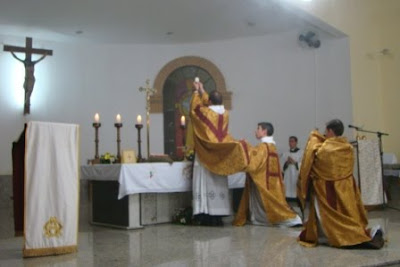
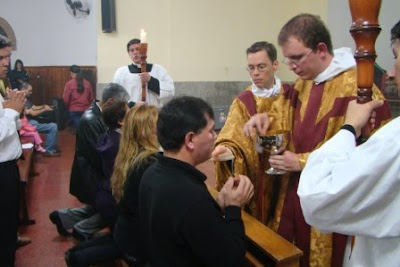
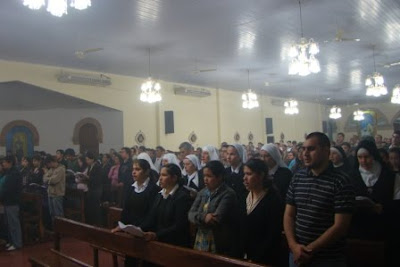
The Missionary Community of Jesus (Comunidad Misionera de Jesús) is a new community of clerics and lay people founded in 2002 and erected as a public association of the faithful in the diocese of Ciudad del Este, Paraguay. Their founder and Superior, Fr. Jorge Miguel Martínez, was ordained to the priesthood (together with nine other diocesan priests) on Sunday, 3 October 2010, by the bishop of Ciudad del Este, Most Rev. Rogelio Livieres Plano. Fr. Martínez celebrated his First Mass on the following day as a Solemn Mass in the Extraordinary Form. Deacon of the Mass was Fr. Dominic Carey, rector of the Major Seminary of Ciudad del Este, and subdeacon Fr. Kevin Liberman, Vicar General of the diocese. The Mass was attended by numerous faithful. You can see a photo gallery here; these are some of the pictures:
(H/t to our friend José Luis Cabrera at Una Voca Málaga.)


(H/t to our friend José Luis Cabrera at Una Voca Málaga.)
Requiem Mass (Usus Antiquior) in the Cathedral of Siena
Approximately two weeks ago, I wrote here of a requiem Mass being offered in the historic cathedral of Siena on Saturday, April 12th in the ancient form.
I'm pleased to report that the NLM successfully managed to solicit pictures for our readership from two of the gentlemen taking part in this liturgical occasion.
I'm pleased to report that the NLM successfully managed to solicit pictures for our readership from two of the gentlemen taking part in this liturgical occasion.

(A rare view inside the Siena sacristy)

(The chapel in the Siena Cathedral where the Mass occured)

(The Poor Knights of Christ)

(You'll note the deacon is a religious, noted by his use of cowl rather than biretta)

(Also note the tonsure)


There will be more photographs coming my way from after the point of the homily, so expect to see more soon.
In the meantime, you may wish to view the full photo gallery up to this point.
Usus Antiquior First Mass in Dolcedo, Italy
Last week, I mentioned two First Masses of diocesan priests in the Extraordinary Form which were going to take place in the diocese of Albenga-Impria, Italy, cf. my post First Masses in the Extraordinary Form which gives details and background. One of these Masses, which took place last Sunday, was celebrated by newly ordained Father Francesco Ramella as a Solemn Mass in the parish church of St. Thomas the Apsotle in Dolcedo, the splendorous and completely intact sanctuary of which you can see in last week's post. Mozart's Spatzenmesse was sung by a choir, as well as Adorabunt Nationes by Himmel, and Ave Verum and Te Deum again by Mozart, whereas the Gregorian propers were sung by the Benedictines of the Immaculate. Some of the canons of the Cathedral and of the Concathedral also attended. Our friends of Messa in latino now have some images of this Mass.
The new priest greeting the faithful:

The sacred ministers - including a presbyter assistens, a privilege for First Masses - approaching the altar:


The NLM's best wishes and congratulations to Don Francesco Ramella and his fellow new priests.
The new priest greeting the faithful:

The sacred ministers - including a presbyter assistens, a privilege for First Masses - approaching the altar:


The NLM's best wishes and congratulations to Don Francesco Ramella and his fellow new priests.
Usus Antiquior Pontifical Mass at Brazilian National Eucharistic Congress
Last Saturday, Msgr. Fernando Arêas Rifan, Ordinary of the Personal Apostolic Administration of Saint John Mary Vianney, celebrated Pontifical Mass in the Extraordinary Form at the XVI National Eucharistic Congress of Brazil. Eight other bishops attended. The blog Fratres in unum has some images.


Pontifical Mass at the Altar of the Chair of St. Peter's: Definitve Programme

A while ago we mentioned that after the conferences of 2008 and 2009, the Italian Association Giovani e Tradizione (Youth and Tradition) and the Sodality Amicizia Sacerdotale Summorum Pontificum (Priestly Friends of Summorum Pontificum), are organising another convention on the motu proprio Summorum Pontificum in Rome at the Angelicum in May 2011, which will conclude with another Pontifical Mass according to the usus antiquior in St. Peter's, this time celebrated by H.Em. Antonio Cardinal Cañizares Llovera, Prefect of the Congregation for Divine Worship and the Discipline of the Sacraments, at the Altar of the Cathedra, on Sunday 15 May 2011. Giovani e Tradizione has now released the definitive programme for the convention: see here and here. Assistant Priest, Deacon and Subdeacon of the Mass will be officials of the Pontifical Commission Ecclesia Dei. The remaining liturgical service will be provided by the Institute of Christ the King Sovereign Priest, while one of the two choirs will be directed by Cardinal Domenico Bartolucci himself.

The Usus Antiquior and Seminarians in De Tiltenberg, the Netherlands
A seminarian from the Netherlands sends in news from the seminary of De Tiltenberg in Vogelenzang.
Recently, a Mass was offered in the seminary, on the feast day of St. Lucy, in the usus antiquior. The Mass was a Low Mass and there are hopes that it might become a monthly affair, serving as part of the formation of the seminarians.


To give you a further flavour, the following is a recording of the Kyrie from the Mass: 


 The Epistle
 The Gospel
 Homily
 Preface
 Consecration
 Last Gospel
 Recessional, with Bach's Fugue on the Magnificat played on the main organ
Recently, a Mass was offered in the seminary, on the feast day of St. Lucy, in the usus antiquior. The Mass was a Low Mass and there are hopes that it might become a monthly affair, serving as part of the formation of the seminarians.


University of Illinois St. John's Newman Centre Usus Antiquior
We mentioned this past Monday that a Mass was being planned by the University of Illinois' St. John's Newman Centre with Fr. Michael Driscoll celebrating.
In follow-up, we are pleased to present the following images from the Mass. The NLM is told that approximately 150 people attended.
In follow-up, we are pleased to present the following images from the Mass. The NLM is told that approximately 150 people attended.


To give you a further flavour, the following is a recording of the Kyrie from the Mass:
Usus Antiquior at Seton Hall University
A reader sent in news of a Mass that was celebrated in the usus antiquior on February 9th at Seton Hall University in the newly renovated Immaculate Conception Chapel. (Readers may recall a story from April 2008 on the NLM of a similar Mass offered at this university, but in a temporary chapel.)
The Mass was offered by Father John Grimm of Immaculate Conception Seminary, with three of the four altar servers for the Mass being seminarians from the same seminary.
The NLM is told that the Mass is part of a series of Masses in the Latin language (in both forms, though primarily in the modern form of the Roman liturgy) that are being offered on Monday evenings at 6pm in the chapel. (It would be interesting to find out more about the other Masses, including whether ad orientem is being used.)
Two more usus antiquior Masses are planned.
The Mass was offered by Father John Grimm of Immaculate Conception Seminary, with three of the four altar servers for the Mass being seminarians from the same seminary.
The NLM is told that the Mass is part of a series of Masses in the Latin language (in both forms, though primarily in the modern form of the Roman liturgy) that are being offered on Monday evenings at 6pm in the chapel. (It would be interesting to find out more about the other Masses, including whether ad orientem is being used.)
Two more usus antiquior Masses are planned.
Monk of Norcia Celebrates Solemn Mass in Usus Antiquior in Louisiana Cathedral
This past Sunday, October 3rd, in the Cathedral of St. John Berchmans, Shreveport, Louisiana, Fr. Benedict Nivakoff, OSB, of the monastery of San Benedetto in Norcia, Italy, celebrated a Solemn Mass in the usus antiquior. The deacon was Fr. Luke Melcher, and the subdeacon, notably, was the rector of this same cathedral, Fr. Peter Mangum. Here are a few photographs.


As has been commented upon the NLM in the past, it is always particularly gratifying to see the usus antiquior and reform of the reform taking place within the context of academic institutions.
Needless to say, it is also gratifying to see the involvement of a seminary professor and seminarians in these events.
Needless to say, it is also gratifying to see the involvement of a seminary professor and seminarians in these events.
Assumption EF high mass in the Oratory
This morning was an exceptionally long haul for us in the Oratory choir, as we had to start rehearsal at 9.00am sharp for the extraordinary form high mass for the Assumption of Our Lady. We were doing the full Palestrina Missa Assumpta Est Maria in six parts, with Palestrina Assumpta Est Maria at the offertory and Robert Parsons' Ave Maria at communion. This as well as all the full Gregorian propers, which were more difficult than usual. So it was a two hour rehearsal for us with no break with high mass at 11.00am, finishing at about 12.30pm. Here is the entrance procession, with our organist improvising on 'Ave Maris Stella':

It was a very successful occasion, with the music much appreciated by everyone, and we had a good crowd. I managed to take a few pictures of the service from the rear gallery where we were in the spare moments I had when I was not singing.
 The Epistle
 The Gospel
 Homily
 Preface
 Consecration
 Last Gospel
 Recessional, with Bach's Fugue on the Magnificat played on the main organ
St. Agnes adds Usus Antiquior to Parish Mass Schedule

The news has been quickly spreading around the Catholic internet world that flagship reform of the reform parish, St. Agnes in St. Paul Minnesota (which Msgr. Richard J. Schuler helped to put on the map) has added the usus antiquior into their parish schedule.
The parish has been celebrating the modern Roman liturgy in a reform of the reform context for quite some time now (and to great acclaim) and from what I understand, they will now in addition begin celebrating the usus antiquior on a semi-monthly Sunday basis, alternating it as the primary parish Sunday Mass with their reform of the reform liturgy -- if any local reader knows more information, please let the NLM know.
The establishment in parishes of both the usus antiquior and the modern liturgy which is being celebrated in a reform of the reform context -- and in sung forms in particular -- is certainly something to be encouraged and fostered, and it seems very much in keeping with the vision of Pope Benedict XVI.
The blog Chris & Co. have some images up from the first of the new Sunday Masses to be celebrated.
The parish has been celebrating the modern Roman liturgy in a reform of the reform context for quite some time now (and to great acclaim) and from what I understand, they will now in addition begin celebrating the usus antiquior on a semi-monthly Sunday basis, alternating it as the primary parish Sunday Mass with their reform of the reform liturgy -- if any local reader knows more information, please let the NLM know.
The establishment in parishes of both the usus antiquior and the modern liturgy which is being celebrated in a reform of the reform context -- and in sung forms in particular -- is certainly something to be encouraged and fostered, and it seems very much in keeping with the vision of Pope Benedict XVI.
The blog Chris & Co. have some images up from the first of the new Sunday Masses to be celebrated.

Usus Antiquior News from Poland
This Sunday, 14 June, two significant Masses were celebrated according to the Extraordinary Form of the Roman Rite in Poland.
In the Franciscan church of St. Anthony in Poznań (Posen), H.E. Grzegorz Balcerek, auxiliary bishop of the Archdiocese of Poznań, sung Pontifical Mass on the occasion of the 15th anniversary of the establishment of a regular celebration of Mass in the usus antiquior in Poznań. The Polish blog Pod Mitrą has excellent images of the occasion, of which here is a selection:


Also on Sunday, in the Church of the Holy Cross in Rzeszów, Fr. Sławomir Jarząb, who was ordained a priest on 30 May by H.E. Kazimierz Górny, the bishop of Rzeszów, celebrated a First Mass as a solemn Mass in the older use. Six others of the twelve priests ordained on 30 May also attended the Mass and imparted their new priest's belssing to the faithful. Nowy Ruch Liturgiczny has photos, here are some of them:


In the Franciscan church of St. Anthony in Poznań (Posen), H.E. Grzegorz Balcerek, auxiliary bishop of the Archdiocese of Poznań, sung Pontifical Mass on the occasion of the 15th anniversary of the establishment of a regular celebration of Mass in the usus antiquior in Poznań. The Polish blog Pod Mitrą has excellent images of the occasion, of which here is a selection:


Also on Sunday, in the Church of the Holy Cross in Rzeszów, Fr. Sławomir Jarząb, who was ordained a priest on 30 May by H.E. Kazimierz Górny, the bishop of Rzeszów, celebrated a First Mass as a solemn Mass in the older use. Six others of the twelve priests ordained on 30 May also attended the Mass and imparted their new priest's belssing to the faithful. Nowy Ruch Liturgiczny has photos, here are some of them:
Usus Antiquior: Sleepy Eye, Minnesota
One of our readers sends in the following photos of a Mass offered in the usus antiquior at the parish of St. Mary Help of Christians in Sleepy Eye, Minnesota.
The church has quite a substantial reredos.
The church has quite a substantial reredos.


The Usus Antiquior and the Major Seminary of Krakow
The Polish blog Nowy Ruch Liturgiczny reports a story about the usus antiquior at the major seminary in Krakow. They report that on Dec. 10th, the major seminary of the archdiocese of Krakow organized a Mass according to the liturgical books of 1962, offered by Fr. Wojciech Grygiel, FSSP, at the invitation of the rector. Here are a few photos of that event.


First Solemn Mass of a New Priest

The Reverend Father Jonathan M. Venner, ordained a Priest for the Diocese of Sioux Falls, SD by His Excellency, the Most Revrerend Paul Joseph Swain on 1st Thursday, August 4th, the Dies Natalis of St. John Marie Vianney, celebrated his First Solemn Mass (in the Usus Antiquior) at St. Mary Church, Salem on 1st Friday, August 5th, 2011. The Votive Mass of the Sacred Heart of Jesus was celebrated, preceded by the Veni Creator Spiritus and followed by the Te Deum.
The Reverend Bryan J. B. Pedersen, Pastor of Sacred Heart Church, Robbinsdale, Minnesota, served as Deacon of the Mass and the Reverend Gregory Parrott, Parochial Vicar of Queen of Angels Church, Austin, Minnesota and Our Lady of Loreto Church, Brownsdale, Minnesota, served as Subdeacon. The Reverend John Brancich, F.S.S.P., Pastor of Immaculate Conception Church, Omaha, Nebraska, served as Master of Ceremonies and Homilist. Mr. Nathan J. Knutson, Diocesan Master of Ceremonies for Diocese of Sioux Falls, South Dakota, directed the Schola Cantorum, while his wife, Mrs. Lisa Knutson, was organist. The Priest of Salem served as Assistant Priest. The Reverend Fathers Charles Duman and Mark Axtmann of the Diocese of Sioux Falls were among the clergy in choir.
Fr. Venner has been assigned as Parochial Vicar at Holy Spirit Catholic Church in Sioux Falls.
Solemn Mass in the Pantheon, Rome, Savoy Family
This past Saturday, March 19th, the Feast of St. Joseph, two Italian associations, Rinnovamento nella Tradizione and Mafalda e Giovanna di Savoia celebrated Mass in the usus antiquior in the Pantheon (Santa Maria ad Martyres) in Rome. The Mass was offered for the repose of the souls of King Umberto II of Italy and Queen Giovanna of Savoy of Bulgaria.
In attendance was Principe Amedeo di Savoia, his wife, Principessa Silvia, and Principessa Maria Gabriella di Savoia. At the end of the Mass, Principe Amedeo, accompanied by relatives and by civil and ecclesiastical authorities, laid a wreath at the tomb of King Vittorio Emanuele II.
The Mass was offered by Don Riccardo Petroni, a priest of the Roman diocese, and ecclesiastical assistant to the association Familia Christi.
In attendance was Principe Amedeo di Savoia, his wife, Principessa Silvia, and Principessa Maria Gabriella di Savoia. At the end of the Mass, Principe Amedeo, accompanied by relatives and by civil and ecclesiastical authorities, laid a wreath at the tomb of King Vittorio Emanuele II.
The Mass was offered by Don Riccardo Petroni, a priest of the Roman diocese, and ecclesiastical assistant to the association Familia Christi.


Image source: Rinnovamento nella Tradizione
Usus Antiquior at St. Charles Borromeo, Kingston-upon-Hull
One of our readers sends in the following photos of a Mass offered in the usus antiquior from the parish of St. Charles Borromeo, Kingston-upon-Hull -- the oldest post-reformation Catholic Church in that city -- which took place this past Sunday, July 4th.
Fr. Stephen Maughan was the celebrant and was assisted by a congregation of approximately 140. The Mass featured music provided by the Cambridge University Polyphonic Choir under the direction of Matthew Ward.
Fr. Stephen Maughan was the celebrant and was assisted by a congregation of approximately 140. The Mass featured music provided by the Cambridge University Polyphonic Choir under the direction of Matthew Ward.


Bishop of Copenhagen, Denmark, Celebrates Usus Antiquior

Last Sunday 2 August, H.E. Most Rev. Czeslaw Kozon, bishop of Copenhagen, Denmark, celebrated Mass according to the usus antiquior, in Copenhagen's church of the Sacred Heart. As the Sankt Karl Borromæus Gruppen, the lay group organising the celebration of Mass in the Extraordinary Form in Copenhagen, reports, when they had difficulties finding priests to celebrate the Mass during the summer time, bishop Kozon generously offered to celebrate the Mass himself this Sunday. At this time, it was not possible to gather the necessary ministers for a Pontifical Mass, hence the Mass was celebrated as a sung Mass; it is hoped that eventually a proper Pontifical Mass will be possible. Nevertheless, this was apparently the first public celebration of the Mass according to the usus antiquior by a bishop in the Nordic countries since the liturgical reforms.
Usus Antiquior at Kenrick-Glennon Seminary
While visiting Kenrick-Glennon Seminary in the Archdiocese of St. Louis to give a workshop, St. Bonventure and the Thought of Benedict XVI, Fr. Damian Peter Fehlner of the Franciscan Friars of the Immaculate, and rector of the Shrine of Our Lady of Guadalupe in LaCrosse, Wisconsin, offered a Missa Cantata in the usus antiquior for the Kenrick seminarians in the School of Theology.
The schola was led by Fr. Samuel Weber, OSB, director of the Institute of Sacred Music, and the servers for the Mass were seminarians from Kenrick.
Kenrick Seminary offers Mass in the usus antiquior every other Friday, alternating with a Mass offered in Latin using the modern Roman liturgical books.
Some photos of this morning's Mass.
The schola was led by Fr. Samuel Weber, OSB, director of the Institute of Sacred Music, and the servers for the Mass were seminarians from Kenrick.
Kenrick Seminary offers Mass in the usus antiquior every other Friday, alternating with a Mass offered in Latin using the modern Roman liturgical books.
Some photos of this morning's Mass.


More from Brazil on the Feast of the Immaculate Conception
The following photos were sent in from a celebration of Mass in the usus antiquior on the feast of the Immaculate Conception. The Mass took place at the Iglesia de Nuestra Señora del Carmen de la Catedral Vieja in Rio De Janeiro, Brazil.


Photos by: James Netusil, Seminarian
Christmas in Imperia
For our second bit of Christmas coverage, we turn to Italy and the following photos which one of our readers sent in, showing the third Mass of Christmas (usus antiquior) as celebrated in the Chiesa è il Santuario N.S. di Loreto in Imperia, the diocese of Bishop Mario Oliveri who will be no stranger to many of our readers.


Archbishop Burke Celebrates Pontifical Mass in the Usus Antiquior in Lourdes
Last Saturday, Feast of St. Marcus, Archbishop Raymond Burke, the Prefect of the Apostolic Signatura, pontificated in the Extraordinary Form in the Basilica of the Immaculate Conception at Lourdes in the context of the annual pilgrimage of the Institute of Christ the King Sovereign Priest (ICRSS). As the Spanish blog Benedicámus Dómino reports, afterwards the Archbishop gave a talk and a Q&A session, and on the Sunday the Superior of the ICRSS, Gilles Wach, celebrated Solemn Mass, again in the Basilica, at which Archbishop Burke assisted.
Here are some picture from Benedicámus Dómino, and also from Fr George David Byers's bloggingLOURDES.
.JPG)

.JPG)
.JPG)


.JPG)
.JPG)
.JPG)
Here are some picture from Benedicámus Dómino, and also from Fr George David Byers's bloggingLOURDES.
.JPG)

.JPG)
.JPG)


.JPG)
.JPG)
.JPG)
Cardinal Burke's Pontifical Mass in Australia
Here are some images of the Pontifical Mass which His Eminence Raymond L. Cardinal Burke celebrated yesterday, 12 March 2011, at St. Brigid's, Marrickville, Sydney. Apparently, there was a very good turnout (over 1000 people). H.E. Most Rev Julian Porteous, Auxiliary Bishop of Sydney, also attended the Mass.


Image Source: Catholic Community of Bl. John Henry Newman. See more photographs at the same community's site here.


Image Source: Catholic Community of Bl. John Henry Newman. See more photographs at the same community's site here.
Cologne Liturgical Conference
As mentioned, the 14th Cologne Liturgical Conference took place from 24 to 27 August. Here is a report sent in to the NLM:
By Christoph Hahn
The Cologne Liturgical Conference is not quite what it seems - because it does not take place (anymore) in Cologne, but - after Bad Münstereifel and other places - in Herzogenrath [near Aachen, Germany]. And the joint event of Una Voce Germany, the initiative groups of Catholic laity and priests in the dioceses of Hamburg, Cologne and Aachen as well as the network of Catholic priests is not just a convention either: not only does it bring the participants up to date in the debate(s) in the traditional camp of the Catholic Church - it also creates a space for encounters between people, priests as well as laity, who often fight on isolated stations for the concerns of Tradition. What unites and sustains them is expressed by the theme of the meeting: "True – real – essential: The presence of Christ in the Blessed Sacrament and the need for an adequate liturgical form".
Organizer Egmont Schulze Pellengahr, a science journalist from Tremsbüttel near Hamburg, was pleased in any case together with the local parish priest, Rev. Dr. Guido Rodheudt, by the participation of around 100 persons mainly from Germany, but also from the Netherlands. The programme of the meeting in Herzogenrath's Nell-Breuning-Haus did not disappoint the audience, who for the most part is enganged in parish pastoral care, in any way. Internationally renowned speakers contributed to the high level, like Rev. Dr. Alcuin Reid, who explained to his audience the way - that was the title of his lecture - "from rubrics to ars celebrandi", and Martin Reinecke, a student of Klaus Gamber, who in his lecture "Did Jesus create a rite? From the Last Supper to the Missa Romensis" formally described the time the Passion and the first early missals, but nevertheless actually surveyed the wide space between antiquity and modern times. At the beginning of the whole meeting, however, was the conveniat for the priests. Its heart: the recollectio of the Munich pastoral theologian Rev. Professor Dr. Andreas Wollbold on "Priestly life from the liturgy".
But it was not just the scientific highlights which adorned the conference. There also was time and space for the art of words, literature. Matthias Matussek, cultural editor of Der Spiegel, who presented his latest book "The Catholic Adventure" turned out to be a veritable magnet for the public and caused an influx of external interested parties, whose numbers eceeded by far the meeting room. Subtle, sophisticated accents were provided for by the matinee "The Cathedral in a nutshell - the Missal of Trent" by and with the writer Martin Mosebach. There was certainly no lack of literary wit at this convention. But its real strength is manifested in the spiritual depth of the presentations and those who gave them.
Among the most striking impressions of the participants were therefore the lectures of the two university theologians among the speakers: Rev. Professor Dr. Peter Hofmann (University of Augsburg) talked about the "Liturgical gesture – Its demands on theology and celebration" and thus, like the parish priest Rev. Dr. Rodheudt with his catechetical talk, turned to practical implementation. Hofmann's colleague, Rev. Professor Dr. Helmut Hoping, a Permanent Deacon, presented the Eucharist as "The gift of the Holy Presence". Father Bernward Deneke, vice rector of the Wigratzbad Seminary of the Fraternity of St. Peter, also stayed close to the reality of the church in his treatment of "liturgical witnesses to the Real Presence".
One of the great highlights of the conference was finally the almost private visit late in the evening to Aachen Cathedral - a spiritual pleasure with performances of the Schola Carolina, led by Dr. Michael Tunger, who had previously introduced the participants to the proprium. Cordiality in dealing with each other also contributed to the fact that many have already firmly marked down the next, the 15th Cologne Liturgical Conference from 16 to 19 August 2012 (www.liturgische-tagung.org), in their calendars.
Some impressions. Pontifical Mass of H.E. Czeslaw Kozon, Bishop of Copenhagen/Denmark:


Pontifical Mass of Dom Josef Vollberg OCSO, Abbot of the Trappist Monastery of Mariawald:


Dom Josef at the conference with writer Martin Mosebach:

Photos: Christoph Hahn/Dominus-Verlag
Assinar:
Postagens (Atom)