CIDADE DO VATICANO, sexta-feira, 3 de setembro de 2010 (ZENIT.org) - Bento XVI afirma que é "vital" para a pessoa "ter raízes e bases sólidas", ao contrário do que afirma o pensamento atual, e por isso convida os jovens a "aprofundar nas raízes" e a buscar "pontos estáveis" que sustentem suas vidas.
Esta é a mensagem entregue hoje aos jovens que participarão da Jornada Mundial da Juventude de Madrid em agosto de 2011, uma mensagem em que o próprio Papa fala sobre seus anos juvenis, suas aspirações e dúvidas.
Na mensagem, o Papa convida os jovens a resistirem ao pensamento actual relativista, a não deixar de aspirar a "uma vida maior", a buscar, em definitivo, o próprio Deus.
"A cultura atual, em algumas partes do mundo, sobretudo no Ocidente, tende a excluir Deus, ou a considerar a fé como um acto privado, sem nenhuma relevância na vida social", apesar de que "o conjunto dos valores, que são o fundamento da sociedade, provenha do Evangelho".
O Papa constata que existe "uma espécie de ‘eclipse de Deus', certa amnésia, mais ainda, uma verdadeira rejeição do cristianismo e uma negação do tesouro da fé recebida, com o risco de perder aquilo que nos caracteriza mais profundamente".
Por isso, convida a "voltar às raízes": "Vós sois o futuro da sociedade e da Igreja. (...) É vital ter raízes e bases sólidas. Isso é verdade, especialmente hoje, quando muitos não têm pontos de referência estáveis para construir sua vida, sentindo-se, assim, profundamente inseguros".
"O relativismo que se difundiu, e para o qual tudo dá na mesma e não existe nenhuma verdade, nem um ponto de referência absoluto, não gera verdadeira liberdade, mas instabilidade, desajuste e um conformismo com as modas do momento", adverte.
Por isso, incentiva os jovens a exigirem "o direito de receber das gerações que vos precedem pontos firmes para fazer vossas opções e construir vossa vida, do mesmo modo que uma planta necessita de um apoio sólido até que cresçam suas raízes, para se converter em uma árvore robusta, capaz de produzir fruto".
"Quais são nossas raízes? - pergunta-se. Naturalmente, os pais, a família e a cultura de nosso país são um componente muito importante de nossa identidade."
No entanto, convida os jovens a irem "além": "enraizar significa voltar a colocar nossa confiança em Deus. D'Ele vem nossa vida. Sem Ele, não poderíamos viver de verdade".
No contexto atual, afirma o Papa, "há uma forte corrente de pensamento laicista que deseja afastar Deus da vida das pessoas e da sociedade, lançando as bases e tentando criar um ‘paraíso' sem Ele".
No entanto, adverte, "a existência ensina que o mundo sem Deus se converte em um ‘inferno', onde prevalece o egoísmo, as divisões nas famílias, o ódio entre as pessoas e os povos, a falta de amor, alegria e esperança".
"Ao contrário, quando as pessoas e os povos acolhem a presença de Deus, adoram-no em verdade e escutam sua voz, constrói-se concretamente a civilização do amor, na qual cada um é respeitado em sua dignidade e assim a comunhão cresce, com os frutos que isso implica."
Assim, adverte: "Há cristãos que se deixam seduzir pelo modo de pensar laicista, ou são atraídos por correntes religiosas que os afastam da fé em Jesus Cristo. Outros, sem deixar-se seduzir por elas, simplesmente deixaram que se esfriasse a sua fé, com as inevitáveis consequências negativas no campo moral".
"Por isso, também eu, como Sucessor do apóstolo Pedro, desejo confirmar-vos na fé (cf. Lc 22, 32). Cremos firmemente que Jesus Cristo se entregou na cruz para oferecer-nos seu amor; em sua paixão, suportou nossos sofrimentos, carregou nossos pecados, alcançou-nos o perdão e reconciliou-nos com Deus Pai, abrindo-nos o caminho da vida eterna."
O Papa conclui a mensagem convidando-os a "dar testemunho da fé na era da globalização".
"Cristo não é um bem somente para nós mesmos, mas é o bem mais precioso que temos para compartilhar com os demais. Na era da globalização, sede testemunhas da esperança cristã no mundo inteiro: são muitos os que desejam receber esta esperança", acrescenta.
terça-feira, 7 de setembro de 2010
VENERABLE PIO XII : La Sagrada Liturgia es, por tanto, el culto público que nuestro Redentor rinde al Padre como Cabeza de la Iglesia, y es el culto que la sociedad de los fieles rinde a su Cabeza, y, por medio de ella, al Padre eterno; es, para decirlo en pocas palabras, el culto integral del Cuerpo místico de Jesucristo; esto es, de la Cabeza y de sus miembros.
1. Cristo e Iglesia
26. Entrando después en la sede de la santidad celestial, quiere que él culto por El instituido y practicado durante su vida terrenal continúe ininterrumpidamente, ya que El no ha dejado huérfano al género humanó, sino qué; igual que lo asiste con su continuo y valioso patrocinio, haciéndose nuestro abogado en el cielo cerca del Padre, así lo ayuda, mediante su Iglesia, en la cual está indefectiblemente presente en el curso de los siglos. Iglesia que EL ha constituido columna de la verdad y dispensadora de la gracia y que, con el sacrificio de la Cruz, fundó, consagró y confirmó para toda la eternidad.
27. La Iglesia, pues, tiene en común con el Verbo encarnado, el fin; la tarea y la función de enseñar a todos la verdad, regir y gobernar a los hombres, ofrecer á Dios sacrificios aceptables y gratos, y así restablecer entré el Creador y las criaturas aquélla unión y armonía que el Apóstol de los gentiles indica claramente con estas palabras: «Por tanto, ya no sois extranjeros u huéspedes, sino conciudadanos de los santos y familiares de Dios, edificados sobre el fundamento de los Apóstoles y de los Profetas, siendo piedra angular el mismo Cristo Jesús, en quien vosotros también sois edificados para morada de Dios en el Espíritu» (Efes. 2, 19-22)). Por esto la sociedad fundada por el divino Redentor no tiene otro fin, sea con su doctrina y su gobierno, sea con el sacrificio y los sacramentos por El instituidos, sea, por fin, con el ministerio que El le confió, con sus plegarias y su sangre, que el de crecer y dilatarse cada vez más; lo que sucede cuando Cristo es edificado y dilatado en las almas de los mortales y cuando inversamente las almas de los mortales son edificadas y dilatadas en Cristo, de manera que en este destierro terrenal prospere el templo en que la divina majestad recibe el culto grato y legítimo.
28. En toda acción litúrgica, por tanto, juntamente con la Iglesia, está presente su Divino Fundador. Cristo está presente en el Augusto Sacramento del Altar, bien en la persona de su ministro, bien, principalmente, bajo las especies eucarísticas; está presente en los Sacramentos con la virtud que en ellos transfunde para que sean instrumentos eficaces de santidad; está presente, por fin, en las alabanzas y en las súplicas dirigidas a Dios, cama está escrito: «Donde están dos o tres congregados en mi nombre, allí estoy yo en medio de ellos» (Mat. 18, 20).
29. La Sagrada Liturgia es, por tanto, el culto público que nuestro Redentor rinde al Padre como Cabeza de la Iglesia, y es el culto que la sociedad de los fieles rinde a su Cabeza, y, por medio de ella, al Padre eterno; es, para decirlo en pocas palabras, el culto integral del Cuerpo místico de Jesucristo; esto es, de la Cabeza y de sus miembros.
Etiquetas:
Mediator Dei
segunda-feira, 6 de setembro de 2010
Vescovo amante della tradizione riapre il seminario chiuso da lustri : Mons. Marc Aillet (nella foto), già vicario generale della trad-friendly diocesi di Tolone, è divenuto vescovo di Bayonne nel 2008. Membro della Comunità S. Martino (fondata dal card. Siri) nella quale si celebra la Messa di Paolo VI in latino e versus Deum, è autore di un testo sul Senso del motu proprio ed ha cercato, nella sua nuova diocesi, di diffondere la Messa tridentina.

Ma la cosa straordinaria è che, vescovo da soli due anni, è stato in grado già da quest'anno di riaprire il seminario diocesano, con cinque aspiranti sacerdoti che proprio nei prossimi giorni inizieranno la loro formazione. Altri candidati inizieranno invece un anno propedeutico, sotto l'assistenza di un sacerdote formatosi in un istituto tradizionalista.
Come si legge nel sito ufficiale della diocesi, l'insegnamento sarà "aperto alla grande Tradizione della Chiesa, tramite la scoperta del Concilio Vaticano II conformemente a 'una ermeneutica della riforma nella continuità dell'unico soggetto-Chiesa', in particolare mediante un insegnamento teologico sicuro e una vera scoperta del tesoro della liturgia romana". Queste parole sono sufficientemente chiare nel tratteggiare il programma di insegnamento che sarà fornito.
Si narra che quando il seminario di Bayonne era stato chiuso, per assenza di candidati, l'allora rettore avesse confezionato un discorsetto in cui si compiaceva di quella chiusura definendola una opportunità per spingere la Chiesa ad esperire nuove strade... come se l'imprenditore fallito considerasse una 'opportunità' il dover depositare i libri contabili in Tribunale.
Ora, cambiato il vescovo, abbiamo ancora una volta una riprova: i progressisti svuotano i seminari, i tradizionalisti li riempiono. Entrambi, in tempi relativamente brevi. Non tutto è perduto, se ci date buoni vescovi.
Fonte: Perepiscopus
visto em:messainlatino.it
Etiquetas:
Difusão Missa Gregoriana
L'USO DEL LATINO NELLE CELEBRAZIONI PONTIFICIE IN GRAN BRETAGNA . LA RIFORMA DELLA RIFORMA DI BENEDETTO XVI
Dall'agenzia heraldscotland alcune novità circa il viaggio apostolico di papa Benedetto in terra inglese.
In un'intervista con The Herald, pubblicata oggi, monsignor Guido Marini, maestro delle cerimonie pontificie, ci anticipa che il Prefazio e il Canone (le parti piu' significative) saranno recitate in Latino. [prassi ben nota nelle celebrazioni papali]
Mons. Marini ha dichiarato: "Per tutte le Messe celebrate nel Regno Unito, il Prefazio e il Canone saranno recitati in latino. Ciò che il Santo Padre si riserva di utilizzare in latino è per sottolineare l'universalità della fede e la continuità della Chiesa ".
Il Canone è la parte più significativa della Messa in quanto precede e segue la consacrazione.
Mons. Marini ha inoltre rivelato una nuova traduzione inglese della Messa, che sarà introdotta il prossimo anno, sarà l'aderenza al latino originale usato dalla Chiesa per 1500 anni prima del Concilio Vaticano del 1960. Parti di esso saranno recitate a Bellahouston per la prima volta.
In un'intervista con The Herald, pubblicata oggi, monsignor Guido Marini, maestro delle cerimonie pontificie, ci anticipa che il Prefazio e il Canone (le parti piu' significative) saranno recitate in Latino. [prassi ben nota nelle celebrazioni papali]Mons. Marini ha dichiarato: "Per tutte le Messe celebrate nel Regno Unito, il Prefazio e il Canone saranno recitati in latino. Ciò che il Santo Padre si riserva di utilizzare in latino è per sottolineare l'universalità della fede e la continuità della Chiesa ".
Il Canone è la parte più significativa della Messa in quanto precede e segue la consacrazione.
Mons. Marini ha inoltre rivelato una nuova traduzione inglese della Messa, che sarà introdotta il prossimo anno, sarà l'aderenza al latino originale usato dalla Chiesa per 1500 anni prima del Concilio Vaticano del 1960. Parti di esso saranno recitate a Bellahouston per la prima volta.
LA RIFORMA DELLA RIFORMA DI BENEDETTO XVI
Pubblichiamo una parte dell'interista edita dal sito inglese Catholic Sentinel rilasciata da mons. Guido Marini in concomitanza del viaggio apostolico di Benedetto XI in Gran Bretagna. La traduzione è nostra.
Nel 2001, il futuro Papa Benedetto XVI ha definito il nuovo movimento liturgico come un progetto per "risvegliare il senso interiore della sacralità". L'allora cardinale Joseph Ratzinger, scrisse: "La cosa più importante oggi è quella di acquisire di nuovo un rispetto per la liturgia e la consapevolezza che non è aperta alla manipolazione. Per imparare ancora una volta a riconoscere nella sua natura, una creazione vivente che cresce ed è stata data come dono attraverso il quale noi partecipiamo alla liturgia celeste. " Rinunciare a cercare in essa la nostra auto-realizzazione, al fine di vedere un dono".Il maestro delle celebrazioni pontificie, mons. Guido Marini, per anni ha auspicato una "riforma della riforma" della liturgia cattolica. Un movimento di rinnovamento sarebbe "in grado di operare una riforma della riforma, o meglio, spostare un passo più avanti nella comprensione dello spirito autentico della liturgia e della sua celebrazione", ha detto mons. Marini. Il liturgista del Papa ha detto che l'obiettivo del nuovo movimento della riforma "sarebbe quello di portare avanti la riforma della liturgia che i padri conciliari avevano lanciato" ma che "non sempre, nella sua attuazione pratica, ha trovato un adempimento tempestivo e felice". Mons. Marini ha aggiunto che "alcuni individui sono riusciti a sconvolgere la liturgia della Chiesa in vari modi, con il pretesto di un elaborata creatività. Ciò è stato fatto per motivi di adattamento alla situazione locale e alle esigenze della comunità, quindi di appropriarsi del diritto di sottrarre, aggiungere o modificare il rito liturgico nel perseguimento di fini soggettivi ed emotivi ".
Egli ha definito tali cambiamenti "follia casuale".
Etiquetas:
A Reforma da Reforma
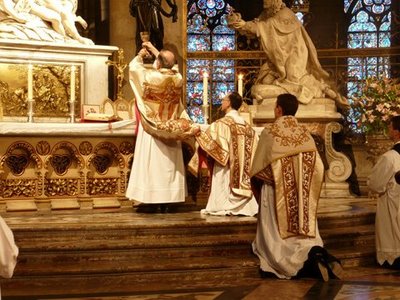
Mater Ecclesiae publica hermosas imágenes de la Solemne Misa Tradicional celebrada el pasado 15 de agosto, en ocasión de la Fiesta de la Asunción de la Ssma. Virgen, en la Parroquia Mater Ecclesiae en Berlín (New Jersey – EEUU). La Misa fue oficiada por el p. Robert Pasley (KHS). Desde el año 2000, dicha parroquia fue designada por el Obispo, Nicholas Di Marzio, a los fines de la utilización exclusiva de los libros litúrgicos antiguos, constituyéndose en la primera de su tipo en los EEUU.
Photo Gallery
Album Number : 96
Click on a thumbnail to view the larger version of that picture or view as slideshow.
Album Number : 96
Click on a thumbnail to view the larger version of that picture or view as slideshow.
Etiquetas:
Difusão Missa Gregoriana
Mass on the Way to Walsingham
Posted by Matthew LMS Chairman has shared some very beautiful images of the Liturgy celebrated as part of a pilgrimage. You can see two very different sanctuaries in these photos yet both successfully convey the holiness of that which belongs to God alone.
Etiquetas:
Difusão Missa Gregoriana
domingo, 5 de setembro de 2010
St. Colman's Liturgy Conference - First Vespers of the Seventh Sunday after Pentecost was celebrated by His Excellency, the Most Reverend Archbishop Raymond Leo Burke, Prefect of the Supreme Tribunal of the Apostolic Signatura.
This evening was held the first liturgical event of the third Liturgical Conference organised by St. Colman's Society for Catholic Liturgy in the Church of Ss. Peter and Paul, Cork.
fonte:http://catholicheritage.blogspot.com/
Etiquetas:
Difusão Missa Gregoriana
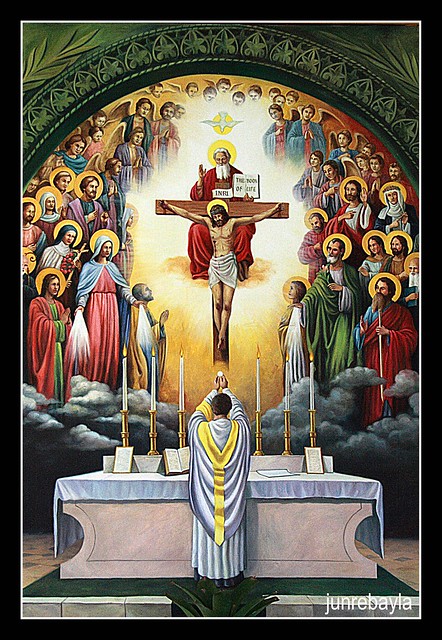
The Holy Sacrifice of the Mass : At the head of all stands of course the High Priest, Christ Himself; to make the Sacrifice of the Cross fruitful for us and to secure its application, He offers Himself as a sacrifice, which is quite independent of the merits or demerits of the Church, the celebrant or the faithful present at the sacrifice.
The word Mass (missa) first established itself as the general designation for the Eucharistic Sacrifice in the West after the time of Pope Gregory the Great (d. 604), the early Church having used the expression the "breaking of bread" (fractio panis) or "liturgy"; the Greek Church has employed the latter name for almost sixteen centuries. There were current in the early days of Christianity other terms;
* "The Lord's Supper" (coena dominica),
* the "Sacrifice" (prosphora, oblatio),
* "the gathering together" (synaxis, congregatio),
* "the Mysteries", and (since Augustine),
* "the Sacrament of the Altar".
What is a Sacrifice?
From the Council of Trent we know the Church intends the Mass to be regarded as a "true and proper sacrifice." If the Mass is to be a true sacrifice in the literal sense, it must realize the philosophical conception of sacrifice. Thus the preliminary question arises: What is a sacrifice in the proper sense of the term? Four things are necessary to any sacrifice:
* a sacrificial gift (res oblata),
* a sacrificing minister (minister legitimus),
* a sacrificial action (actio sacrificica), and
* a sacrificial end or object (finis sacrificii).
(1) The sacrificial gift must exist in Physical substance, and must be really or virtually destroyed (i.e. animals slain, libations poured out, other things rendered unfit for ordinary uses), or at least really transformed, at a fixed place of sacrifice (ara, altare), and offered up to God.
(2) As regards the person offering, it is not permitted that any and every individual should offer sacrifice on his own account. Only a qualified person (usually called priest, sacerdos, lereus), who has been given the power by commission or vocation, may offer up sacrifice in the name of the community. After Moses, the priests authorized by law in the Old Testament belonged to the tribe of Levi, and more especially to the house of Aaron. But, since Christ Himself received and exercised His high priesthood, not by the arrogation of authority but in virtue of a Divine call, there is still greater need that priests who represent Him should receive power and authority through the Sacrament of Holy Orders, to offer up the sublime Sacrifice of the New Law.
(3) Sacrifice reaches its culmination in the sacrificial act, in which we have to distinguish between the proximate matter and the real form. The form lies, not in the real transformation or complete destruction of the sacrificial gift, but rather in its sacrificial oblation, in whatever way it may be transformed. Even where a real destruction took place, as in the sacrificial slayings of the Old Testament, the act of destroying was performed by the servants of the Temple, whereas the proper oblation, consisting in the "spilling of blood" (aspersio sanguinis), was the exclusive function of the priests. Thus the real form of the Sacrifice of the Cross consisted neither in the killing of Christ by the Roman soldiers nor in an imaginary self-destruction on the part of Jesus, but in His voluntary surrender of His Blood shed by another's hand, and in His offering of His life for the sins of the world. Consequently, the destruction or transformation constitutes at most the proximate matter; the sacrificial oblation, on the other hand, is the physical form of the sacrifice.
(4) Finally, the object of the sacrifice, as significant of its meaning, lifts the external offering beyond any mere mechanical action into the sphere of the spiritual and Divine. The object is the soul of the sacrifice, and, in a certain sense, its "metaphysical form". In all religions we find, as the essential idea of sacrifice, a complete surrender to God for the purpose of union with Him; and to this idea there is added, on the part of those who are in sin, the desire for pardon and reconciliation. Hence, at once arises the distinction between sacrifices of praise and expiation (sacrificium latreuticum et propitiatorium), and sacrifices of thanksgiving and petition (sacrificium eucharisticum et impetratorium); hence also the obvious inference that under pain of idolatry, sacrifice is to be offered to God alone, as the beginning and end of all things
If then we combine the above four constituent ideas in a single definition, we may say:
"Sacrifice is the external oblation to God by an authorized minister of a sense-perceptible object, either through its destruction or at least through its real transformation, in acknowledgement of God's supreme dominion and of the appeasing of His wrath."

The First Priest
The Council of Trent laid stress on the prophetical relation that undoubtedly exists between the offering of bread and wine by Melchizadek, and the Last Supper of Jesus. The occurrence was briefly as follows: After Abraham (then still called "Abram") with his armed men had rescued his nephew Lot from the four hostile kings who had fallen on him and robbed him, Melchizadek, King of Salem (Jerusalem), "bringing forth bread and wine, for he was a priest of the Most High God, blessed him [Abraham] and said: Blessed be Abram by the Most High God . . . And he [Abraham] gave him the tithes of all".
Catholic theologians have from the beginning rightly emphasized the circumstance that Melchizadek brought out bread and wine, not merely to provide refreshment for Abram's followers wearied after the battle, for they were well supplied with provisions out of the booty they had taken, but to present bread and wine as food-offerings to Almighty God. Not as a host, but as "priest of the Most High God", he brought forth bread and wine, blessed Abraham, and received the tithes from him. In fact, the very reason for his "bringing forth bread and wine" is expressly stated to have been his priesthood: "for he was a priest." Accordingly, Melchizadek made a real food-offering of bread and wine. Now it is the express teaching of Scripture that Christ is "a priest for ever according to the order of Melchizadek". Christ, however, in no way resembled his priestly prototype in His bloody sacrifice on the Cross, but only and solely at His Last Supper. On that occasion He likewise made an unbloody food-offering. He accomplished something more than a mere oblation of bread and wine, namely the sacrifice of His Body and Blood under the forms of bread and wine. Since the Mass is nothing else than a continual repetition, commanded by Christ Himself, of the Sacrifice accomplished at the Last Supper, it follows that the Sacrifice of the Mass partakes of the New Testament fulfillment of the prophecy of Melchizedek.
Other Old Testament Reference to the Mass
Passing over the more or less distinct references to the Mass in other prophets, the best and clearest prediction concerning the Mass is undoubtedly that of the prophet Malachi, circa 500 B.C., who makes a threatening announcement to the Levite priests in the name of God: "I have no pleasure in you, saith the Lord of hosts: and I will not receive a gift of your hand. For from the rising of the sun even to the down, my name is great among the Gentiles, and in every place there is sacrifice, and there is offered to my name a clean oblation: for my name is great among Gentiles, saith the Lord of hosts" (Malachi 1:10-11). According to the interpretation of the Fathers of the Church, the prophet here foretells the everlasting Sacrifice of the New Dispensation. For he declares that these two things will certainly come to pass:
* The abolition of all Levitical sacrifices, and
* the institution of an entirely new sacrifice.
As God's determination to do away with the sacrifices of the Levites is adhered to consistently throughout the denunciation, the essential thing is to specify correctly the sort of sacrifice that is promised in their stead. In regard to this, the following propositions have to be established:
* That the new sacrifice is to come about in the days of the Messiah;
* that it is to be a true and real sacrifice, and
* that it does not coincide formally with the Sacrifice of the Cross.
The sacrifice referred to by Malachi did not signify a sacrifice of his time, but was rather to be a future sacrifice belonging to the age of the Messiah.

The Last Supper was to be that first sacrifice.
New Testament Reference to the Mass
(1) Passing now to the proofs contained in the New Testament, we may begin by remarking that many dogmatic writers see in the dialogue of Jesus with the Samaritan woman at Jacob's well a prophetic reference to the Mass (John 4:21): "Woman believe Me, that the hour cometh, when you shall neither on this mountain [Garizim] nor in Jerusalem, adore the Father .... But the hour cometh and now is, when the true adorers shall adore the Father in spirit and in truth." Since the point at issue between the Samaritans and the Jews related, not to the ordinary, private offering of prayer practiced everywhere, but to the solemn, public worship embodied in a real Sacrifice, Jesus really seems to refer to a future real sacrifice of praise, which would not be confined in its liturgy to the city Jerusalem, but would captivate the whole world.
(2) The feeding of the multitude in the wilderness, contained in all four Gospels, foreshadows Jesus as the Bread of Life. In John (6:26-27) Jesus says:

The Institution of the Eucharist - by JOOS van Wassenhove -
"I am telling you the truth; you are looking for Me because you ate the bread and had all you wanted, not because you understand my miracles. Do not work for food that spoils; instead, work for food that lasts for eternal life. This is the food which the Son of Man will give you, because God the Father has put His mark of approval on Him."
(3) The tearing of the huge Temple Veil into two pieces, by an Act of God, as Jesus expired on the Cross, is the final sign of the Sacrifice of the Mass to come. In order to understand and appreciate the significance of the torn veil, we first need to understand the significance of the veil itself. The veil was a thick veil made of woven linen that separated the holy place in the tabernacle from the Most Holy Place. Into this Most Holy Place, no one was allowed to enter except Israel's high priest. Even he could enter only once a year with the blood of a sacrifice. Only after he had made an offering for his sins could he offer the blood of a sacrifice for the sins the people had committed in ignorance. The plain significance of the linen curtain was that the old covenant could not reveal the way for the sinner's approach to God. It does not require a wild imagination or inspired ingenuity to find a symbolical significance for the tabernacle veil. Scripture makes the Holy Spirit's intention concerning this matter very clear. It stood as a symbol of the old covenant's inability to reveal the way into God's holy presence. The priests of the old covenant had to repeat the same sacrificial ritual year-after-year, thus signifying that God had not truly forgiven the sins for which they had offered the sacrifice. The Day of Atonement was a solemn reminder that guilty, covenant-breaking sinners could not approach a holy God. The best the old covenant sacrifices could do was to provide ceremonial cleansing for sins committed unintentionally. They could formally restore the relationships that had been broken between a man and his God and a man and his neighbor, but they could not take away those sins that had caused the breach.
cruxrain.gif (108617 bytes)The tearing of the temple veil is full of significance for the New Covenant people of God. The radical earthquakes that accompanied this event, as well as the event itself, bears eloquent testimony that the redemptive work of Christ effected far more than a mere "change of administration" within an overarching covenant of grace. His redemptive word was a divine intervention in history that inaugurated a new age; a new creation. Those who belong to this new creation are heirs of better promises that are granted by a new and better covenant. The old order has passed away, and the new order has come to stay. As a result, the most holy place on earth during the old covenant order was no longer holy. Forty years later the Roman Legions of Titus would completely destroy the Temple. The number Forty is a time of preparation for the New.
It is first of all necessary to make clear that in every sacrifice of the Mass four distinct categories of persons really participate.
(1) At the head of all stands of course the High Priest, Christ Himself; to make the Sacrifice of the Cross fruitful for us and to secure its application, He offers Himself as a sacrifice, which is quite independent of the merits or demerits of the Church, the celebrant or the faithful present at the sacrifice.
(2) Next after Christ, and in the second place, comes the Church as a juridical person, who, according to the express teaching of the Council of Trent has received from the hands of her Divine Founder the institution of the Mass and also the commission to ordain priests and to have celebrated by these the most venerable Sacrifice. This intermediate stage between Christ and the celebrant may be neither passed over nor eliminated, since a bad and immoral priest, as an ecclesiastical official, does not offer up his own sacrifice -- which indeed could only be impure -- but the immaculate Sacrifice of Christ and His spotless Bride, which can be soiled by no wickedness of the celebrant. However, the greatness and extent of this ecclesiastical service is dependent on the greater or less holiness of the reigning pope, the bishops, and the clergy throughout the World, and for this reason in times of ecclesiastical decay and laxity of morals (especially at the papal court and among the episcopate) the fruits of the Mass, resulting from the sacrificial activity of the Church, might under certain circumstances, easily be very small.
(3) With Christ and His Church is associated in third place the celebrating priest, since he is the representative through whom the real and the mystical Christ offer up the sacrifice. If, therefore, the celebrant be a man of great personal devotion, holiness, and purity, there will accrue an additional fruit which will benefit not himself alone, but also those in whose favor he applies the Mass.
(4) Finally, in the fourth place, must be mentioned those who participate actively in the Sacrifice of the Mass, e.g., the servers, lectors, organist, singers, and the whole congregation joining in the sacrifice. The more fervent the prayer, the richer the fruit. Most intimate is the active participation in the Sacrifice of those who receive Holy Communion during the Mass, since in their case the special fruits of the Communion are added to those of the Mass.

Papal Guidance Concerning the Mass
"At the Last Supper, on the night He was handed over, Our Lord instituted the Eucharistic Sacrifice of His Body and Blood, to perpetuate the sacrifice of the cross throughout the ages until He should come, and thus entrust to the Church, His beloved spouse, the memorial of His death and resurrection: a sacrament pope.jpg (20780 bytes)of devotion, a sign of unity, a bond of charity, a paschal banquet in which Christ is received, the soul is filled with grace and there is given to us the pledge of future glory."
"The Mass in fact truly makes present the sacrifice of the Cross. Under the species of bread and wine, upon which has been invoked the outpouring of the Spirit who works with absolutely unique power in the words of consecration, Christ offers Himself to the Father in the same act of sacrifice by which He offered Himself on the Cross. 'In this divine sacrifice which is accomplished in the Mass, the same Christ who offered Himself once and for all in a bloody manner on the altar of the Cross is contained and is offered in an unbloody manner'. To His sacrifice, Christ unites the sacrifice of the Church: 'In the Eucharist the sacrifice of Christ becomes also the sacrifice of the members of His Body. The lives of the faithful, their praise, sufferings, prayer and work, are united with those of Christ and with his total offering, and so acquire a new value'. The truth that the whole community shares in Christ's sacrifice is especially evident in the Sunday gathering, which makes it possible to bring to the altar the week that has passed, with all its human burdens." . . . . by Pope John Paul II
Conclusion
eucharist.jpg (55349 bytes)
The Institution of the Eucharist - by JOOS van Wassenhove -
from Galleria Nazionale delle Marche, Urbino
No feast better exemplifies Catholicism than Holy Thursday's Mass of the Lord's Supper for it was at the Last Supper Jesus Christ instituted the Blessed Sacrament when He turned the bread He offered His disciples into His Own Flesh and the wine into His Precious Blood. Though the physical properties of the bread remain the same, when He pronounced the words "Take this, all of you, and eat it: this is My Body which will be given up for you." it became His Body.
Then, as the Canon of the Mass says, "When supper was ended, He took the cup. Again He gave you thanks and praise, gave the cup to His disciples, and said: 'Take this, all of you, and drink from it. This is the cup of My Blood, the Blood of the New and Everlasting Covenant. It will be shed for you and for all so that sins may be forgiven. Do this in memory of me.'" At that very moment the wine, still wine in all physical aspects, became His Precious Blood.
Jesus used bread, for He is the "Bread of Life" (John 6:35 ) and wine for He is the "true Vine" (John 15:1). The fruit of the vine becomes the fruits of Redemption, made possible by Christ's death, a death which totally made it possible for every one of God's children to be redeemed. The only difference between the Sacrifice of the Cross and the Sacrifice of the Mass is that on the former, Jesus physically shed His Blood, while in the latter there is no physical shedding of blood nor physical death because Christ has already been immolated once.
By His death He gained for us the merit and, through the Holy Sacrifice of the Mass, applies to us that merit and reward of His Bloody Death through the unbloody oblation of His Body and Blood during Mass. It is very similar to what one would see on video tape. What was taped happened at the moment it was being filmed. purgatory_mass_cross.jpg (30913 bytes)When it is being played over and over, no matter how many times, it is a re-enactment of the event.
Though it cannot happen again, we are reliving it as though it were. So also, in the Holy Sacrifice of the Mass, Jesus continues to offer Himself as a Sacrifice in order to unite us with Him, to give us a gift worthy to be offered to God (Malachi 1:11), "a clean oblation" and allow us the opportunity to share in the merits of His eternal Sacrifice on the Cross. The fruits of attending Mass worthily, and in the state of grace are that He not only answers our heartfelt prayers, but we gain even more of the merits of Christ for our souls, as well as gaining temporal blessings.
When we consider these things, isn't it sad that so few attend Daily Mass? Isn't it even sadder that so many Catholics attend Sunday Mass without truly realizing what they are partaking in? We need to re-emphasize the Holy Sacrifice of the Mass, to instill in all the Catholic faithful the value of the Mass which is infinite because it is the renewal of Christ's death.
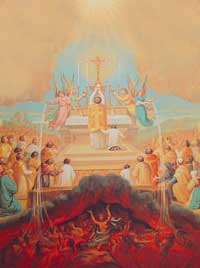
Therefore to attend Mass devoutly is the greatest prayer we can offer. There is no more holy and divine act that can be performed here on earth than the Holy Sacrifice of the Mass. We need to let all our brothers and sisters know that all who participate in the Mass, both here on earth and in Purgatory, reap the general fruits since the Holy Sacrifice of the Mass is offered for everyone. This not only includes all who are present, or assist, especially the priest who represents Christ, but also the person for whom it is being offered as well as the souls in Purgatory - the Church Suffering.
Why go to Daily Mass?
littlegoldcross.gif (962 bytes)Every Mass is worth as much as the sacrifice of Our Lord's life, sufferings, and death.
littlegoldcross.gif (962 bytes)Holy Mass is the world's most powerful atonement for your sins.
littlegoldcross.gif (962 bytes)At the hour of death the holy Masses you have heard devoutly will be your greatest consolation.
littlegoldcross.gif (962 bytes)Every Mass will go with you to judgment and plead for pardon.
littlegoldcross.gif (962 bytes)At Mass, you can diminish more or less temporal punishment due to your sins, according to your fervor.
littlegoldcross.gif (962 bytes)Assisting devoutly at Holy Mass, you render to the sacred humanity of Our Lord the greatest homage.
littlegoldcross.gif (962 bytes)He forgives the venial sins which you have not confessed. The power of Satan over you is diminished. He supplies for many of your negligence and omissions.
littlegoldcross.gif (962 bytes)You are preserved from dangers and misfortunes which otherwise might have befallen you. You shorten your Purgatory.
littlegoldcross.gif (962 bytes)Every Mass wins for you a higher degree of glory in Heaven.
littlegoldcross.gif (962 bytes)You receive the priest's blessing which Our Lord ratifies in Heaven.
littlegoldcross.gif (962 bytes)You kneel amidst a multitude of holy angels, who are present at the adorable Sacrifice with reverential awe.
littlegoldcross.gif (962 bytes)You are blessed in your temporal goods and affairs.
littlegoldcross.gif (962 bytes)By piously hearing Holy Mass you afford the Souls in Purgatory the greatest possible relief.
littlegoldcross.gif (962 bytes)One Mass heard during life will be of more benefit to you than many heard for you after your death.
Etiquetas:
Teologia Santa Missa
Damos Graças a Deus por Jesus Cristo Nosso Senhor por termos superado os 250 000 visitantes: a Ele a Glória , a Honra e o Poder para sempre. Ámen.Todos os amigos que nos visitam estão de parabéns por darem a conhecer,a amar e a difundir a Missa Gregoriana em Portugal , pela qual estamos unidos ao Vigário de Cristo na Terra que deseja ardentemente que o Tesouro e a Beleza da Missa Gregoriana seja conhecida e oferecida em todas as Paróquias da Igreja Católica.
Bento XVI convida os jovens a buscarem suas próprias raízes: o Papa convida os jovens a resistirem ao pensamento actual relativista, a não deixar de aspirar a "uma vida maior", a buscar, em definitivo, o próprio Deus. "A cultura atual, em algumas partes do mundo, sobretudo no Ocidente, tende a excluir Deus, ou a considerar a fé como um acto privado, sem nenhuma relevância na vida social", apesar de que "o conjunto dos valores, que são o fundamento da sociedade, provenha do Evangelho". Por isso, convida a "voltar às raízes": "Vós sois o futuro da sociedade e da Igreja. (...) É vital ter raízes e bases sólidas. Isso é verdade, especialmente hoje, quando muitos não têm pontos de referência estáveis para construir sua vida, sentindo-se, assim, profundamente inseguros". "O relativismo que se difundiu, e para o qual tudo dá na mesma e não existe nenhuma verdade, nem um ponto de referência absoluto, não gera verdadeira liberdade, mas instabilidade, desajuste e um conformismo com as modas do momento", "enraizar significa voltar a colocar nossa confiança em Deus. D'Ele vem nossa vida. Sem Ele, não poderíamos viver de verdade".Cremos firmemente que Jesus Cristo se entregou na cruz para oferecer-nos seu amor; em sua paixão, suportou nossos sofrimentos, carregou nossos pecados, alcançou-nos o perdão e reconciliou-nos com Deus Pai, abrindo-nos o caminho da vida eterna."
O relativismo não dá liberdade, mas instabilidade, afirma
Bento XVI visita localidade onde nasceu Leão XIII. Na homilia da Missa pede que os católicos sejam uma força pacifica de mudança .Antes do Angelus o Papa apresentou a sua mensagem aos jovens pedindo-lhes disponibilidade a pagar pessoalmente pelo bem, a justiça e a verdade.

Gioacchino Pecci, que viria a ser o Papa Leão XIII, nasceu em Carpineto a 2 de Março de 1810, Destacou-se pela sua encíclica “Rerum Novarum”, de 15 de Maio de 1891, sobre os direitos e deveres do capital e do trabalho, em que introduziu a ideia da subsidiariedade no pensamento social católico.
Esta encíclica marcou o início da sistematização do pensamento social católico, chamado vulgarmente de Doutrina social da Igreja Católica.
Em Carpineto, Bento XVI presidiu a uma Missa na Praça Monti Lepini, na presença de cerca de 5 mil fiéis.
"O seu testemunho seja sempre corajoso e o seu serviço profético, possa em cada momento manifestar aquilo que é chamado a dizer no nome de Jesus. Foi com estas palavras que o bispo de Anagni-Alatri D. Lourenço Loppa se dirigiu ao Papa acolhendo-o na Praça central da terra natal de Leão XIII. D. Loppa recordou que esta visita do Papa representa o ponto culminante do ano de celebrações para o segundo centenário do nascimento do Papa da Rerum Novarum e que nos fala do amor de Deus, vasto e interminável, fiel a si mesmo que, como em todas as estações da historia, sobretudo naquelas atormentadas e difíceis, sabe garantir á sua Igreja o guia seguro e iluminado de Pedro.
Na homilia da Missa Bento XVI exortou os católicos a uma ampla reflexão sobre o impulso de promoção humana trazido pelo Cristianismo no caminho da civilização e também sobre o método e o estilo de tal contributo, conformes ás imagens evangélicas da semente e do fermento: “no interior da realidade histórica os cristãos, agindo como simples cidadãos ou de uma forma associada, constituem uma força pacifica de mudança profunda, favorecendo o desenvolvimento das potencialidades internas á própria realidade.”
“É esta a forma de presença e de acção no mundo proposta pela doutrina social da Igreja, que tem como objectivo o amadurecimento das consciências como condição de válidas e duradoiras transformações”.
Numa época de áspero anticlericalismo e de manifestações acesas contra o Papa, Leão XIII soube guiar e sustentar os católicos no caminho de uma participação constructiva, rica de conteúdos, firme nos princípios e capaz de abertura.
Imediatamente depois da sua encíclica Rerum Novarum, de facto, verificou-se na Itália e noutros Países uma autentica explosão de iniciativas: associações caixas rurais e artesanais, jornais, um vasto movimento que teve no servo de Deus José Toniolo o animador iluminado.
Leão XIII - sublinhou Bento XVI - era um Papa muito idoso, mas sábio e clarividente, e pode assim introduzir no século XX uma Igreja rejuvenescida , com uma atitude justa para enfrentar os novos desafios. Era um Papa ainda politica e fisicamente prisioneiro no Vaticano, mas na realidade, com o seu Magistério, representava uma Igreja capaz de enfrentar sem complexos as grandes questões do mundo contemporâneo”.
Após a celebração, Bento XVI regressou de helicóptero a Castel Gandolfo, residência pontifícia de Verão para presidir a oração mariana do Angelus do meio dia .
| |
Nas palavras proferidas nesta ocasião, depois de pedir desculpa pelo atraso, devido á sua deslocação de helicóptero de Carpineto Romano para Castelgandolfo, o Santo Padre apresentou brevemente a sua mensagem publicada nos dias passado, e dirigida aos jovens do mundo inteiro para o XXVI dia mundial da juventude que terá lugar em Madrid em Agosto do próximo ano.
O tema escolhido para esta mensagem retoma uma expressão da Carta aos Colossenses do apostolo Paulo: “enraizados e edificados n’Ele, tornando-vos firmes na fé. Decididamente – salientou o Papa – uma proposta contra-corrente . De facto, perguntou o Papa, quem é que hoje propõe aos jovens de serem enraizados e firmes?
Exalta-se sobretudo a incerteza, a mobilidade, a volubilidade…todos eles aspectos que reflectem uma cultura indecisa acerca dos valores de fundo, aos princípios na base dos quais orientar e regular a própria vida.
O Jovem – salientou depois Bento XVI - é como uma árvore que cresce: para se desenvolver bem precisa de raízes profundas que em caso de tempestades de vento o mantenham bem firme no terreno.
Assim, também a imagem do edifício em construção faz presente a exigência de fundamentos validos para que a casa seja sólida e segura.
O Santo Padre referiu - se depois ao coração da sua mensagem aos jovens: as palavras “em Cristo” e “na fé”.
O amadurecimento pleno da pessoa, a sua estabilidade interior, têm o fundamento na relação com Deus, relação que passa através do encontro com Jesus Cristo. Uma relação de confiança profunda, de autentica amizade com Jesus é capaz de dar a um jovem aquilo de que precisa para enfrentar bem a vida: serenidade e luz interior, aptidão a pensar positivamente, generosidade em relação aos outros, disponibilidade a pagar de pessoa pelo bem, a justiça e a verdade.
Um ultimo aspecto muito importante. Para se tornar crente, o jovem é sustentado pela fé da Igreja; se nenhuma pessoa é uma ilha, menos ainda o é o cristão, que descobre na Igreja a beleza da fé partilhada e testemunhada juntamente com os outros na fraternidade e no serviço da caridade
Bento XVI concluiu pedindo que a Virgem Maria acompanhe com a sua protecção o caminho das comunidades e dos grupos juvenis para o grande encontro de Madrid de 2011
Assinar:
Postagens (Atom)


fonte:http://acatholiclife.blogspot.com/